


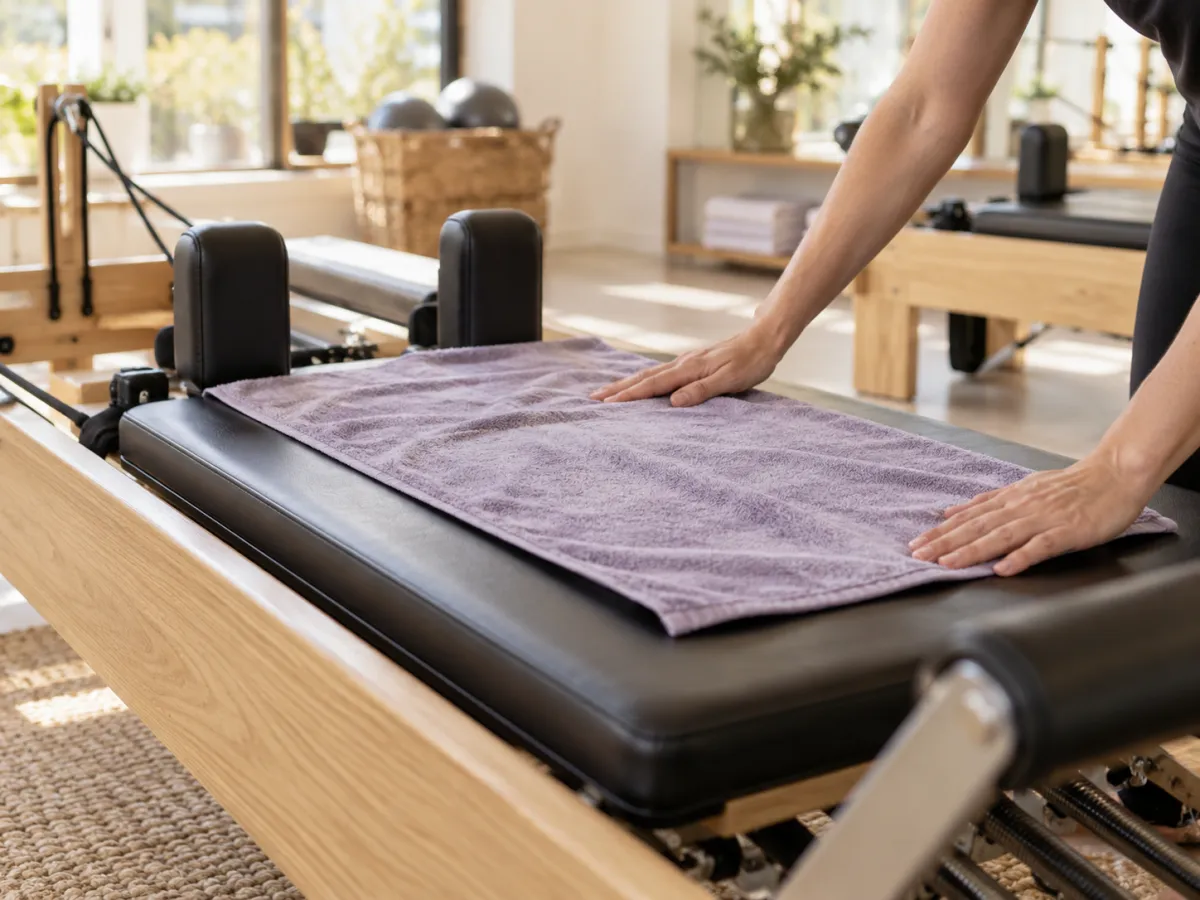
Practitioners who rely on a grip towel for pilates reformer classes often wonder how to use a non slip reformer towel at home to maintain scapular anchoring, pelvic imprint control, and closed-chain sliding mechanics between studio visits. In the studio, a low-profile towel prevents upper-back slipping on vinyl Reformer upholstery while keeping sweat off shared pads; on a home floor mat or hardwood surface, that same dual-surface towel becomes both a high-friction thoracic anchor and a folded gliding or cushioning tool for Reformer-inspired sequences. By understanding which carriage mechanics translate to floor friction and which require honest spring-tension substitutions, you can run a precise, joint-friendly home workout with your studio towel.
According to the PilatesFits catalog listing, the Pilates Towels collection provides towels for mat and studio sessions with per-style dimensions and care instructions.
How Grip Towel For Pilates Reformer Translates Reformer Mechanics to the Floor
A studio Reformer combines a rolling carriage, adjustable coil springs, a fixed footbar, and raised shoulder blocks. While a grip towel for pilates reformer or non slip reformer towel cannot generate mechanical spring recoil on its own, it directly replicates three essential biomechanical sensations from the Reformer carriage:
- Thoracic & Scapular Shear Resistance: During Reformer footwork, bridging, and overhead coordination, your upper back presses downward and backward against the carriage pad. Laying a non slip reformer towel flat across your home mat creates the same high-friction tactile zone under your scapulae so your ribcage stays anchored as your legs extend into long-lever tabletop positions.
- Controlled Floor Gliding on Smooth Hardwood or Tile: When folded into a compact square with the smooth woven face against a clean hardwood or tile floor, a studio towel allows your supporting foot or palm to slide outward and draw inward—translating the eccentric lengthening and concentric adductor pull of Reformer scooter lunges, side splits, and plank pikes.
- Targeted Cervical and Patellar Elevation: Folding a grip towel for pilates reformer into a dense, flat rectangle beneath your occiput replicates the slight elevation of an angled Reformer headrest, while placing it under your knees during quadruped knee stretches cushions the patellar tendon without the unstable wobble of a thick cushion.
| Studio Reformer Movement | At-Home Grip Towel Setup & Orientation | Primary Biomechanical Cue | Honest Mechanical Difference vs Studio Machine |
|---|---|---|---|
| Supine Footwork & Shoulder Bridge | Towel laid flat across upper two-thirds of floor mat beneath scapulae | Press shoulder blades wide into towel weave while articulating spine vertebra by vertebra | Gravity and bodyweight replace closed-chain horizontal coil spring push |
| Standing Scooter & Carriage Lunge | Front foot in grip socks on mat; back foot on folded towel edge on smooth floor | Keep pelvis square and front knee stacked over second toe as back leg glides | Floor friction provides steady drag rather than increasing spring tension |
| Quadruped Knee Stretch & Arabesque | Towel folded flat into dense pad under both knees; toes curled on mat | Draw lower ribs toward iliac crests while hovering knees slightly off towel | Core anti-extension replaces pulling against carriage shoulder blocks |
| Long Stretch & Plank Pike Flow | Forearms or palms anchored on non-slip towel surface; feet gliding on floor | Protract scapulae and lift hips from deep lower abdominals on the exhale | Concentric hip flexion pulls legs inward instead of carriage springs assisting |
| Short Box Round Back & Oblique Twist | Towel rolled tightly and wedged lightly behind sacrum on the mat | Lengthen crown of head upward before rounding lumbar spine against towel roll | Tactile sacral feedback cues lumbar C-curve without a wooden footstrap |
To choose a studio-ready towel that transitions smoothly between carriage sessions and home mat flows, explore the PilatesFits Pilates Towels collection and pair your setup with high-traction PilatesFits grip socks.
Step-by-Step Non Slip Reformer Towel Sequence: Core, Glutes & Spinal Articulation
Use your grip towel for pilates reformer or non slip reformer towel to move through this structured three-part home sequence focusing on eccentric control and spinal articulation:
- Supine Scapular Anchor & Articulated Bridging: Smooth your towel flat over your mat so it supports your head, upper back, and sacrum. Inhale laterally into your side ribs; exhale to imprint your lumbar spine and peel your hips upward into a bridge while pressing your arms firmly into the towel surface. Pause at the top to verify level hip bones, then articulate down slowly through each thoracic and lumbar segment.
- Towel-Tug Hundreds & Single-Leg Stretch: Hold the top corners of a folded towel taut between both hands with arms extended toward the ceiling. Gently pull outward on the towel corners to fire your serratus anterior and latissimus dorsi—recreating the upper-body connection of Reformer arm straps—while lifting into a thoracic curl and alternating long-lever leg extensions.
- Unilateral Standing Scooter Glides: Stand with your working foot anchored on your mat and your opposite foot resting on a folded corner of your towel over smooth flooring. Inhale as you slide the back leg outward into a controlled lunge while maintaining a forward torso diagonal; exhale to drive through your standing heel and draw the sliding leg inward without shifting your pelvis.
Setup Boundaries and Progression Rules Without a Studio Machine
To get consistent results from your grip towel for pilates reformer without form breakdown or premature fabric wear, follow these setup boundaries and progression guidelines:
- Check Per-Style Dimensions and Backing Before Dual-Surface Use: Towels vary in length, width, fabric weave, and backing construction. Always inspect the dimensions and product details for your specific towel style rather than assuming every towel includes silicone grip dots or pre-cut Reformer shoulder-block openings.
- Progress via Tempo and Lever Length Rather Than Momentum: Because floor exercises lack heavy spring resistance, increase muscular time under tension by slowing the eccentric phase of every lunge, bridge, and abdominal lower, or by holding isometric pauses at the longest lever angle.
- Follow Per-Style Washing Care Instructions After Floor Sessions: Using a towel on both studio Reformers and home floors requires consistent hygiene. Check the care instructions for your specific style and launder regularly without heavy softeners so the weave retains its surface friction and absorbency.
Frequently Asked Questions
What should you consider when choosing a Pilates or Reformer towel for carriage hygiene, grip, and fabric feel?
When packing a Pilates or reformer towel for mat and studio sessions, shoppers should check dimensions and care instructions for each style so the towel fits the mat or Reformer carriage and stays hygienic between classes. A low-profile, tightly woven surface helps prevent bunching beneath the spine while maintaining dependable traction under sweat.
Can grip towel for pilates reformer replace a studio Reformer workout at home?
A grip towel for pilates reformer cannot replicate adjustable metal coil springs or an elevated rolling carriage, but it effectively translates Reformer alignment cues, scapular traction, upper-body strap tension (when held taut between the hands), and controlled floor gliding into a home mat workout.
How do you structure a balanced non slip reformer towel routine for core and lower body?
Structure a balanced non slip reformer towel routine by starting with supine spinal articulation and bridging on the flat towel surface, moving into supine abdominal series while pulling gently outward on a folded towel to engage the lats, and finishing with unilateral standing lunges and quadruped core stabilization.
Make it part of your practice
Explore the purple dotted yoga mat towel and check its product details before choosing your studio essentials.
View this piece