


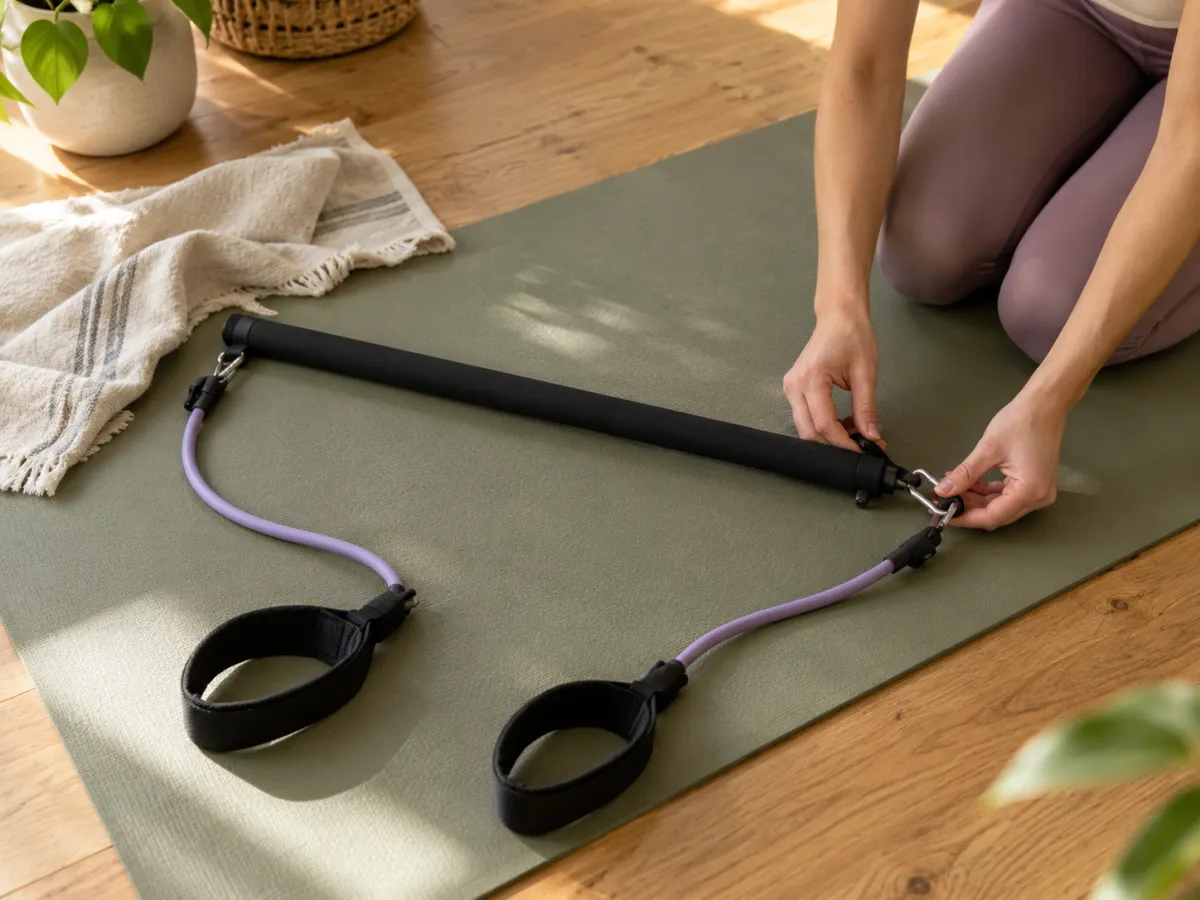
When practitioners ask, “does the Pilates bar work?”, the honest biomechanical answer depends on two variables: whether you eliminate elastic slack at the start of each movement, and whether your kit lets you scale resistance once your neuromuscular coordination adapts. A portable bar with resistance bands is highly effective for building deep core endurance, scapular stability, and eccentric hip control—provided you do not outgrow a single fixed light cord or let band recoil pull your lumbar spine out of neutral alignment.
According to the PilatesFits catalog listing, the Pilates Bars & Kits collection covers detachable Pilates bars and kits with resistance bands, compared by assembled length, included accessories, and resistance options.
The Biomechanics Behind Does The Pilates Bar Work in Mat and Reformer Movements
Evaluating how a portable Pilates bar works requires looking at how closed-chain elastic tension interacts with your axial skeleton. Unlike free weights that rely strictly on gravity pulling straight toward the floor, a Pilates bar creates a direct line of tension between the anchor point (typically your arches in the foot straps) and the bar held in your hands or resting across your hips.
First, examine pelvic neutrality under elastic recoil. During supine leg presses or tabletop extensions, the elastic bands pull your femurs back toward your chest. If you allow that recoil to passively snap your knees inward, your pelvis rocks into a posterior tilt and unloads the deep transverse abdominis. Controlling the return phase forces your lumbopelvic stabilizers to work eccentrically throughout the entire range of motion.
Second, consider ribcage closure and scapular tracking. When pressing the bar overhead or performing seated roll-downs, the rigid shaft keeps both hands equidistant. If your thoracic spine is stiff or the band tension is poorly matched to your shoulder strength, your lower ribs will flare forward to fake overhead mobility. Maintaining gentle front-rib connection while driving the bar from your serratus anterior ensures the resistance targets postural muscles rather than straining the anterior shoulder capsule.
Third, address progressive overload and neuromuscular adaptation. As Reddit Pilates practitioners frequently point out, a basic step-on bar with a single light elastic tube attached to a stick feels engaging during the first few sessions, but once that baseline tension feels easy, simply performing higher repetitions cannot drive ongoing strength adaptations. Meaningful Pilates bar results require modular kits with carabiner-clipped stackable bands so mechanical tension scales alongside your strength.
3 Common Mistakes With Pilates Bar Results and How to Fix Each One
If your sessions feel too easy or leave your neck and lower back fatigued instead of your core and glutes, use the diagnostic matrix below to identify and fix the underlying mechanical error:
| Common Training Mistake | Biomechanical Cause | Why It Stalls Pilates Bar Results | Immediate Tactile & Setup Fix | Target Muscle Recruitment Restored |
|---|---|---|---|---|
| Dead-Zone Cord Slack in Bottom Range | Band resting length exceeds limb distance during bent-knee or bottom squat positions | Zero mechanical tension during the first half of the concentric press | Shorten nylon strap buckles or widen stance so tension begins before joint extension | Full-range gluteus maximus, quadriceps, and lower abdominal engagement |
| Relying on a Single Fixed Light Band | Using a non-modular step-on stick after initial motor learning completes | Insufficient mechanical load for progressive strength adaptation | Clip multiple stackable resistance cords together for compound lower-body sets | Progressive overload for glutes, hamstrings, and spinal extensors |
| Anterior Rib Thrust on Overhead Presses | Compensating for tight lats or excessive band load by arching the thoracolumbar junction | Shifts load from core and shoulder girdle into lumbar hyperextension | Soften sternum down toward the mat and unclip one band for upper-body sets | Deep core stabilizers (transverse abdominis) and serratus anterior |
| Uncontrolled Eccentric Snap-Back | Letting band elasticity pull limbs back rapidly after peak extension | Eliminates eccentric time under tension where Pilates control is built | Count a slow, deliberate return pace while resisting the cord recoil | Eccentric hamstring, oblique, and hip flexor control |
| Narrow or Asymmetrical Hand Placement | Gripping inside shoulder width or allowing one side of the bar to tilt | Forces wrist ulnar deviation and uneven unilateral rotation | Align knuckles with outer shoulders and keep the bar parallel to the collarbone line | Symmetrical latissimus dorsi, rotator cuff, and oblique co-contraction |
Self-Check Alignment Protocol Before Your Next Session
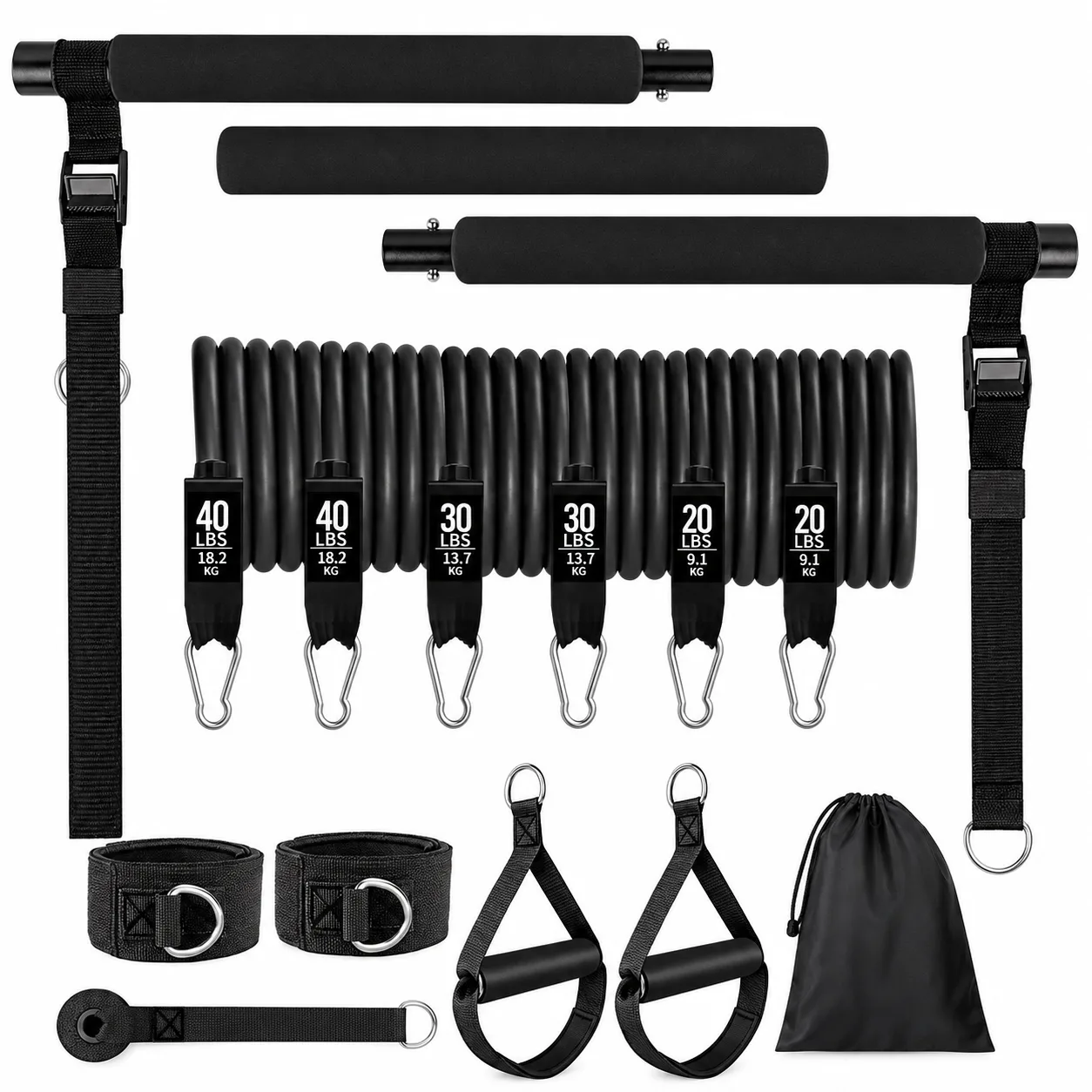
Before starting a routine with equipment from the PilatesFits Pilates Bar collection, run through this four-step alignment and tension verification protocol to maximize your Pilates bar results:
- Test baseline tension at your starting joint angle: Sit or lie in your starting position before beginning a set. If the cords hang loose until your legs or arms are nearly straight, adjust the strap buckles so the bands are taut from the first inch of movement.
- Match cord combinations to muscle group size: Use stacked medium-to-heavy band combinations for supine footwork, standing squats, and hip bridges, then step down to a single lighter band when transitioning to seated spine twists, mermaid reaches, or biceps and triceps isolation.
- Verify neutral wrist and arch alignment: Keep your wrists flat rather than cocked backward against the bar’s foam padding, and position the foot loops securely across the center of your arches so tension travels cleanly through your heels.
- Pair with standalone bands for accessory activation: Supplement your bar flows with flat loops from the Pilates Resistance Bands collection when you want to add lateral hip abduction tension around the thighs during bar-loaded squats or bridges.
Frequently Asked Questions
How do portable 3-section Pilates bar kits work, and what resistance features prevent plateauing once the base band feels easy?
A portable multi-section Pilates bar assembles into a rigid padded shaft with elastic bands anchored to end-caps and foot loops, creating closed-chain resistance between your upper and lower body. To prevent plateauing once the initial band feels easy, look for kits with carabiner-clipped stackable bands and adjustable strap lengths so you can progressively increase tension rather than relying on a single fixed cord.
What is the most common mistake people make when testing whether the Pilates bar works?
The most common mistake is using a single light band with slack in the bottom half of the movement and rushing the return phase. Eliminating cord slack, slowing down the eccentric return, and clipping heavier stackable bands for lower-body exercises immediately increases muscular time under tension.
How do Pilates bar results affect alignment and muscle activation in Pilates?
Because the rigid shaft connects both limbs to the same resistance path, consistent Pilates bar training improves bilateral symmetry, eccentric core bracing, and scapular depression—helping practitioners notice and correct one-sided hip shifts or rib flaring during both mat and Reformer sessions.
Make it part of your practice
Explore the purple pilates bar with resistance cords and check its product details before choosing your studio essentials.
View this piece