


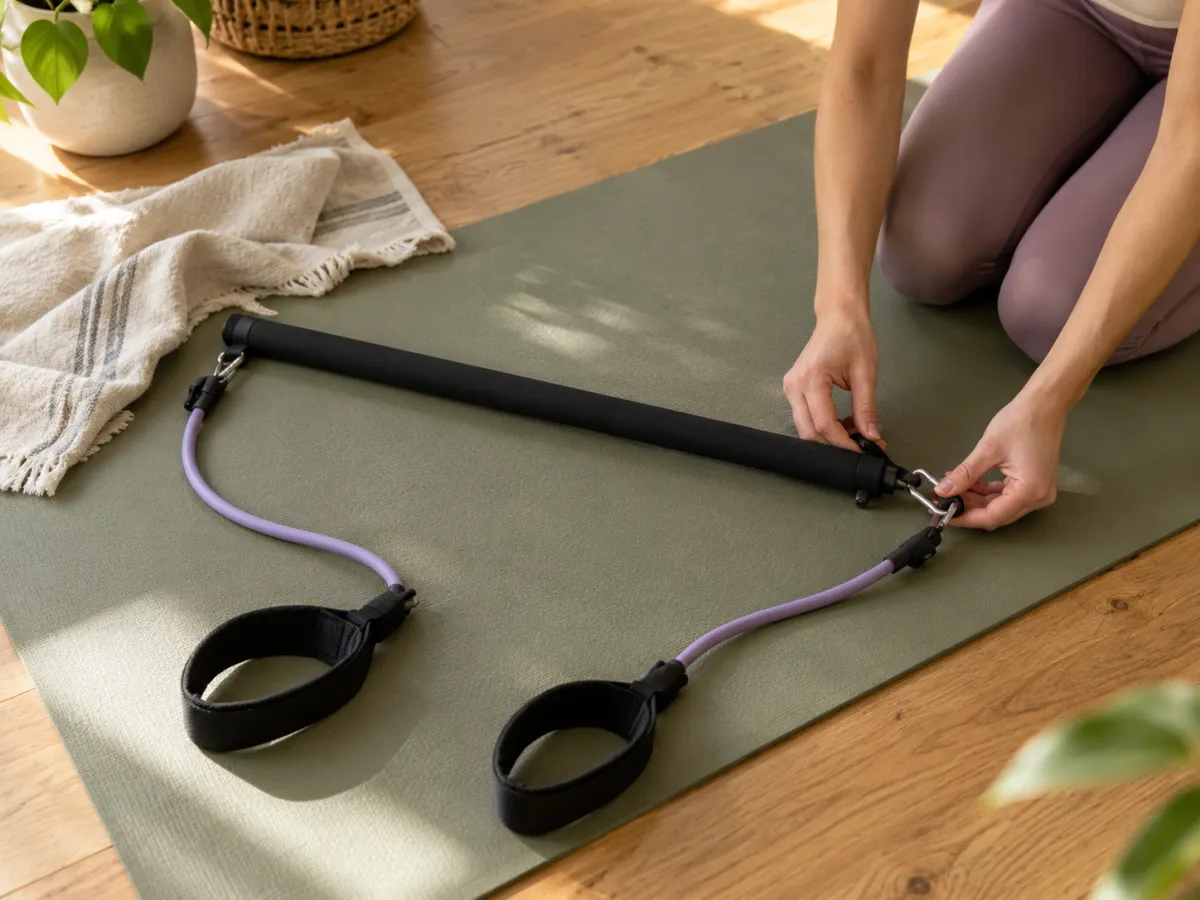
Choosing a portable Pilates bar kit comes down to three structural details: how wide the assembled bar spans across your shoulders and hips, how the resistance bands attach and scale in tension, and whether the connector joints stay rigid under rotational and pressing loads. A basic step-on bar paired with a single light elastic cord can introduce beginners to standing roll-downs and supine leg presses, but practitioners quickly hit a mechanical ceiling if the kit lacks interchangeable or stackable resistance bands.
According to the PilatesFits catalog listing, the Pilates Bars & Kits collection covers detachable Pilates bars and kits with resistance bands, compared by assembled length, included accessories, and resistance options.
Key Specifications to Compare When Shopping for Pilates Bar
When evaluating a detachable Pilates bar against a multi-band portable Pilates bar kit, the physical specifications directly govern which exercises feel fluid and which feel cramped. Unlike a studio Cadillac push-through bar anchored to a rigid overhead frame, a portable bar relies on opposing tension between your anchor limb (usually the feet or hips) and your working limb (hands, shoulders, or legs).
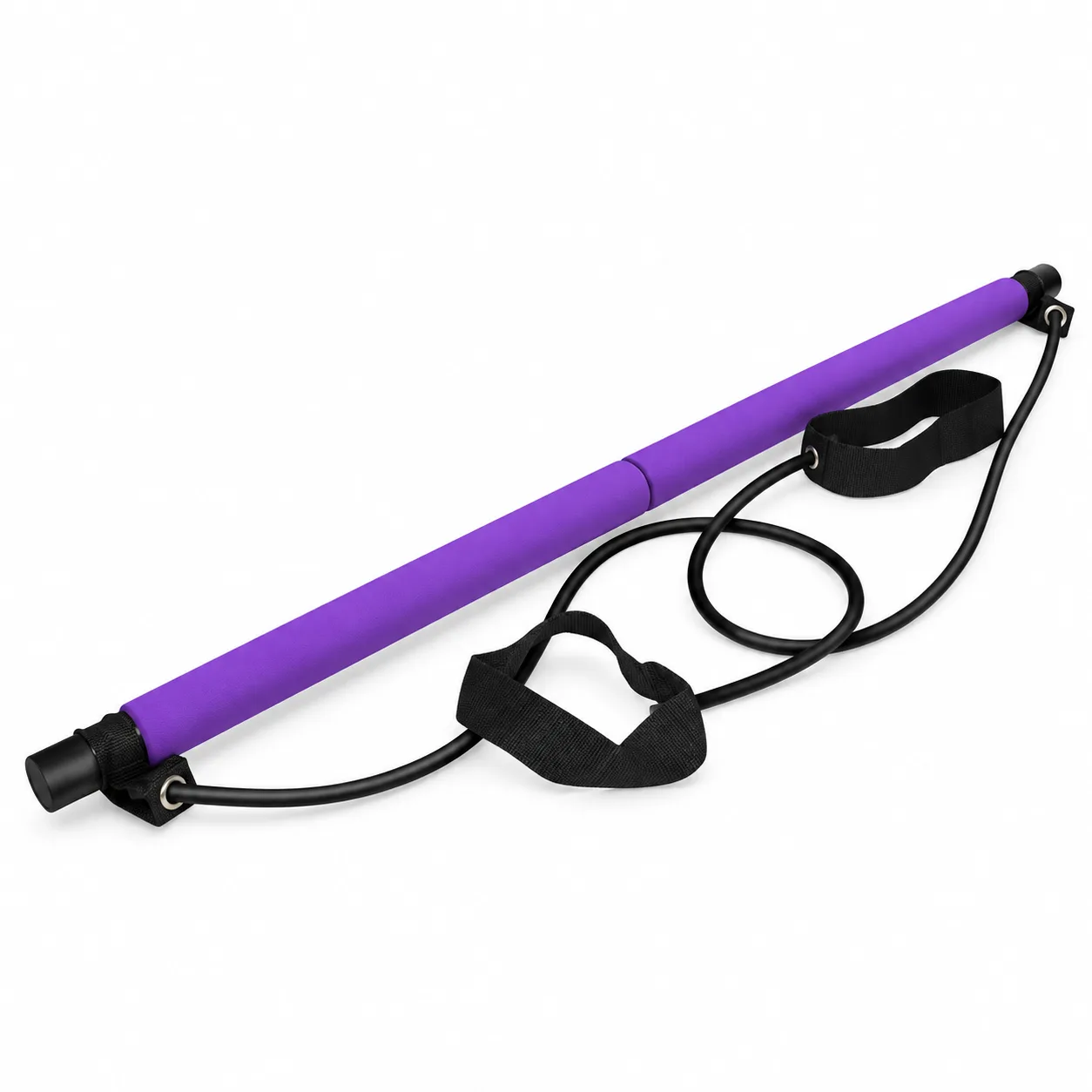
First, examine assembled bar length. If the assembled shaft is too narrow relative to your shoulder width, your wrists are forced into ulnar deviation during chest presses, overhead shoulder flexion, and wide-grip swan variations. Conversely, a well-proportioned multi-section shaft allows a neutral, shoulder-width or slightly wider grip while giving your hips enough lateral clearance during seated spine twist and mermaid variations.
Second, inspect connector mechanism and core rigidity. Multi-section portable bars typically join via internal spring-button pins or threaded steel couplings. Threaded couplings generally minimize rotational play when the bands pull asymmetrically during unilateral lunges or oblique twists, whereas loose pin joints can click or shift slightly as tension changes direction.
Third, prioritize resistance architecture and progressive overload. Reddit Pilates practitioners frequently note that a basic step-on bar with a single fixed elastic tube feels supportive at first, but once that baseline tension becomes easy, your only option is adding repetitions rather than increasing load. A complete portable Pilates bar kit solves this limitation by using carabiner-clipped stackable bands—allowing you to combine light, medium, and heavy cords as your core stability and lower-body strength progress.
Pilates Bar vs Portable Pilates Bar Kit: Side-by-Side Comparison Matrix
To see how a standalone single-band Pilates bar compares with a modular portable Pilates bar kit, review the five structural and biomechanical dimensions below:
| Specification Dimension | Basic Single-Band Pilates Bar | Modular Portable Pilates Bar Kit | Biomechanical & Training Impact |
|---|---|---|---|
| Resistance Architecture | Single fixed elastic tube attached directly to bar ends | Interchangeable, carabiner-clipped stackable resistance bands | Stackable bands allow true progressive overload across upper- and lower-body movements |
| Assembled Shaft Width | Often shorter compact tube optimized for light travel | Full multi-section steel core with high-density foam grip | Proper width preserves neutral wrist and glenohumeral alignment on presses and rows |
| Foot & Hand Interface | Simple sewn fabric loops at band ends | Dual-function adjustable foot straps, ankle cuffs, and hand grips | Adjustable straps accommodate different limb lengths and secure barefoot or grip-sock arches |
| Joint Coupling Stability | Basic push-pin segments prone to slight rotational play | Precision threaded or reinforced locking ferrules | Eliminates mid-rep wobble during unilateral standing balance and rotational core work |
| Accessory Versatility | Bar and attached cords only | Door anchor, ankle straps, carry bag, and multi-tension cords | Expands repertoire from mat supine leg series to standing rows and kneeling chest presses |
Step-by-Step Selection Checklist for Studio and Home Practitioners
Before selecting a setup from the PilatesFits Pilates Bar collection, walk through this four-point fit and mechanics checklist to ensure the apparatus matches your body proportions and training goals:
- Check your standing and supine slack point: If you have a shorter torso or shorter inseam, a non-adjustable cord may remain slack during the bottom half of a squat or supine leg press. Look for kits with adjustable nylon webbing buckles or swivel end-caps that let you shorten the effective cord path without wrapping the latex around the metal shaft.
- Verify multi-band clipping hardware: Inspect whether the bar ends use rotating metal eyelets and carabiners rather than permanently crimped plastic caps. Rotating eyelets prevent the bands from tangling around your forearms as you transition from biceps curls into overhead tricep extensions.
- Evaluate foam grip density and sweat resistance: Closed-cell NBR or EVA foam padding prevents skin pinching when the bar rests across your upper traps during standing squats or across your pelvis during weighted hip bridges.
- Plan complementary band progressions: If you already use flat loops or figure-8 cords from the Pilates Resistance Bands collection, pairing them with a multi-band bar kit lets you isolate smaller scapular stabilizers before moving into compound bar-guided presses.
Frequently Asked Questions
How do portable 3-section Pilates bar kits work, and what resistance features prevent plateauing once the base band feels easy?
A portable multi-section Pilates bar locks together into a padded rigid shaft with elastic bands anchored to rotating end-caps. You place the foot loops over your arches (or attach a door anchor) to create closed-chain spring-like tension. To avoid plateauing once the base band feels easy, choose a kit with carabiner-clipped stackable bands so you can combine multiple tension levels rather than relying on a single fixed cord.
What specifications matter most when comparing a Pilates bar?
The three most important specifications are assembled bar length (to maintain neutral shoulder and wrist alignment), joint locking mechanism (threaded or reinforced couplings that resist twisting), and cord adjustability (buckle straps or stackable carabiners that match tension to your height and limb length).
How does a basic Pilates bar compare to a full portable Pilates bar kit for regular home sessions?
A basic Pilates bar typically pairs a compact sectional stick with one fixed resistance cord, making it best suited for light mobility, postural warm-ups, and high-repetition endurance. A full portable Pilates bar kit adds multiple stackable band tensions, adjustable foot straps, and anchor accessories so you can scale resistance for progressive glute, leg, and core conditioning.
Make it part of your practice
Explore the black pilates bar and resistance accessory system and check its product details before choosing your studio essentials.
View this piece