


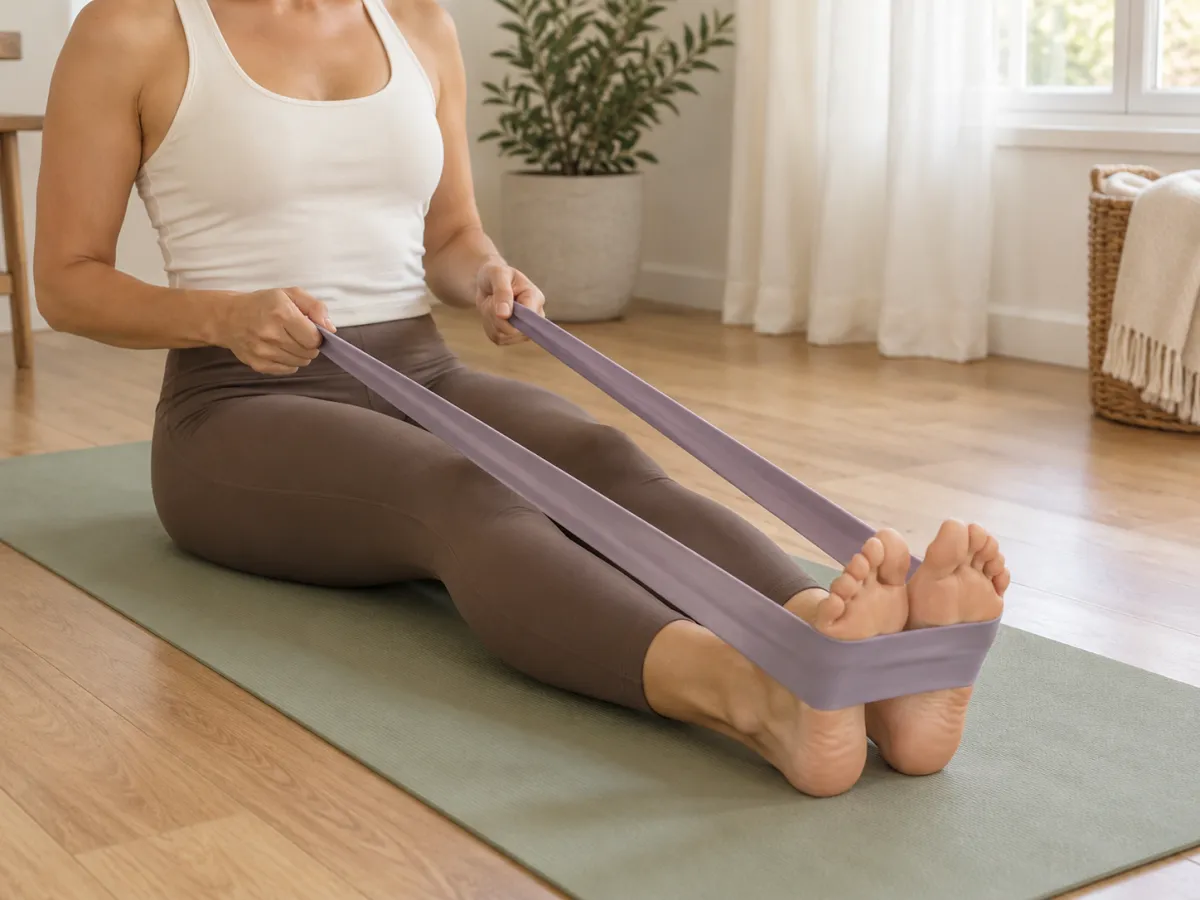
Selecting properly sized latex free resistance bands and understanding the mechanical differences in tpe vs latex resistance bands ensures your bands stay securely anchored without slack, rolling, or studio allergy conflicts. Whether you are packing a personal band kit for a latex-free Pilates studio or setting up a home mat space, band length, loop circumference, and elastomer recovery behavior determine whether you experience smooth tension through full-range leg circles and rowing or frustrating dead zones at the start of every rep.
According to the PilatesFits catalog listing, the Pilates Resistance Bands collection includes portable loop and long-band formats organized by listed resistance level.
By matching loop circumference and long-band reach to your height and limb proportions—and stepping up across multiple listed resistance levels—you achieve consistent tension in every posture. Browse portable loop and long-band options in the PilatesFits Pilates Resistance Bands collection and complement your floor setup with the PilatesFits Pilates Sliders collection.
Why Sizing and Proportions Matter for Latex Free Resistance Bands in Motion
In Pilates, a resistance band functions as an extension of your limbs. When sizing latex free resistance bands, two dimensional mismatches commonly disrupt movement quality:
Long-Band Reach vs Torso and Leg Length
During supine Feet-in-Straps equivalents, Seated Roll-Downs, and Kneeling Chest Expansion, the band travels from the arches of your feet to your hands. A long band that is too short for a taller practitioner forces premature peak tension and restricts hip flexion, while gripping too far toward the ends on a long band leaves slack at the bottom of the movement. Adjusting your hand wrap along a full-length band lets you calibrate pre-stretch tension to your exact inseam and arm span.
Mini-Loop Circumference and Material Modulus in TPE vs Latex Resistance Bands
When comparing tpe vs latex resistance bands, thermoplastic elastomer (TPE) provides a hypoallergenic, odor-free, smooth-surface alternative to natural rubber latex. Because TPE has a slightly firmer initial stretch modulus than natural latex of the same thickness, choosing the right loop flat width and listed resistance level prevents cuff dig-in while keeping constant lateral tension around the thighs, shins, or ankles.
Latex Free Resistance Bands vs Tpe Vs Latex Resistance Bands: Measurement & Fit Chart by Body Type
Use this sizing and material decision chart to match latex free resistance bands and tpe vs latex resistance bands to your body proportions, movement goals, and studio environment.
| Practitioner Profile / Movement Scenario | Recommended Band Format & Sizing Fit | TPE vs Latex Material Selection | Grip & Anchor Proportion Adjustment | Studio Etiquette & Safety Standard |
|---|---|---|---|---|
| Petite Practitioners / Short-Lever Arm & Core Work | Long band with a choked-up grip wrap + light/medium mini loop band | Latex-free TPE or natural latex (per studio policy) | Wrap the long band once around the palm to eliminate slack in tabletop | Keep excess band ends tucked neatly on the mat away from neighboring carriages |
| Tall Practitioners / Long-Inseam Supine Leg Circles | Full-length long band or long continuous loop held near the ends | High-elongation flat TPE or latex long band | Anchor flat across the center of both foot arches without double-wrapping the palms | Verify full overhead and leg-extension clearance before starting supine flows |
| Lower-Body Glute Bridge & Lateral Abduction Focus | Closed mini loop band sized for above-knee or mid-shin placement | Latex-free TPE mini loop or wide woven fabric glute loop | Position cuff flat two finger-widths above the patella with feet hip-distance apart | Check individual SKU descriptions to confirm latex-free status for sensitive skin |
| Allergy-Sensitive Studio & Shared Class Environments | Complete multi-tension kit of portable loop and long-band formats | Strictly verified latex free resistance bands (TPE or latex-free fabric) | Label or color-sort personal bands by listed resistance level for quick transitions | Many clinical and boutique Pilates studios require 100% latex-free props in group rooms |
| Progressive Home Strength & Reformer Simulation | Combined set of mini bands + challenging long loop band across multiple levels | TPE or latex formats graded from light to heavy listed resistance | Pair ankle/thigh mini loop with foot-anchored long band for dual-vector loading | Step up to the next listed resistance rating once 3-second eccentric control feels easy |
First-Class Verification Test Before Stepping Onto the Carriage
Before bringing new latex free resistance bands into a studio class or starting a home session with gear from the PilatesFits Pilates Resistance Bands collection, run this three-step fit and etiquette check:
- Confirm SKU-Specific Material Labeling: When evaluating tpe vs latex resistance bands for allergy compliance, never assume all elastic or fabric bands are latex-free unless explicitly stated on the specific product listing.
- Perform the Tabletop & Seated Reach Test: Sit tall with legs extended and wrap your long band flat across both foot arches. With elbows bent at ninety degrees beside your ribs, the band should feel taut without pulling your shoulders forward. If you feel slack, choke your grip closer to your shins; if the band restricts your posture, widen your grip toward the ends.
- Test Multi-Tension Mini Loop Stability With Sliders: Place a mini loop band above your knees and perform three slow bridge marches or lunges paired with discs from the PilatesFits Pilates Sliders collection. Confirm the band stays flat without rolling and that your kit includes multiple listed resistance levels so you can scale challenge as your strength adapts.
- Keep Practical Boundaries in Mind: Woven fabric glute loops do not have the same stretch elongation ratio as long flat latex or TPE bands, community recommendations on combining mini and long bands reflect attributed user experience, and stepping up to higher tension ratings over time is required to maintain progressive overload.
Frequently Asked Questions
How do I choose the right size or dimension for latex free resistance bands?
To choose the right fit for latex free resistance bands, pair a full-length band (which allows you to adjust your hand grip closer or further from your feet to match your inseam and torso height) with closed mini loop bands across multiple listed resistance levels. Taller practitioners should grip near the ends of a long band for supine leg circles, while petite practitioners can wrap the band once around the palm to remove initial slack.
What should I know about tpe vs latex resistance bands before attending a studio Pilates class?
When comparing tpe vs latex resistance bands for studio classes, thermoplastic elastomer (TPE) bands are completely free of natural rubber proteins, making them compliant with latex-free studio policies and safe for practitioners with contact sensitivities. Always verify on the specific product listing that a band is labeled latex-free, and wipe TPE bands clean after class so studio floor dust does not reduce their grip.
Why do home Pilates practitioners combine mini bands and long loop resistance bands across multiple tension levels?
Pilates resistance bands are selected across loop and long-band formats by listed resistance level, because combining mini bands and a challenging long loop band across multiple tension levels allows progressive overload as strength improves. Mini bands provide compact lateral resistance around the thighs and ankles, while long loop bands accommodate full-body pressing, rowing, and spinal articulation across different body proportions.
Make it part of your practice
Explore the pink flat resistance band roll and check its product details before choosing your studio essentials.
View this piece