


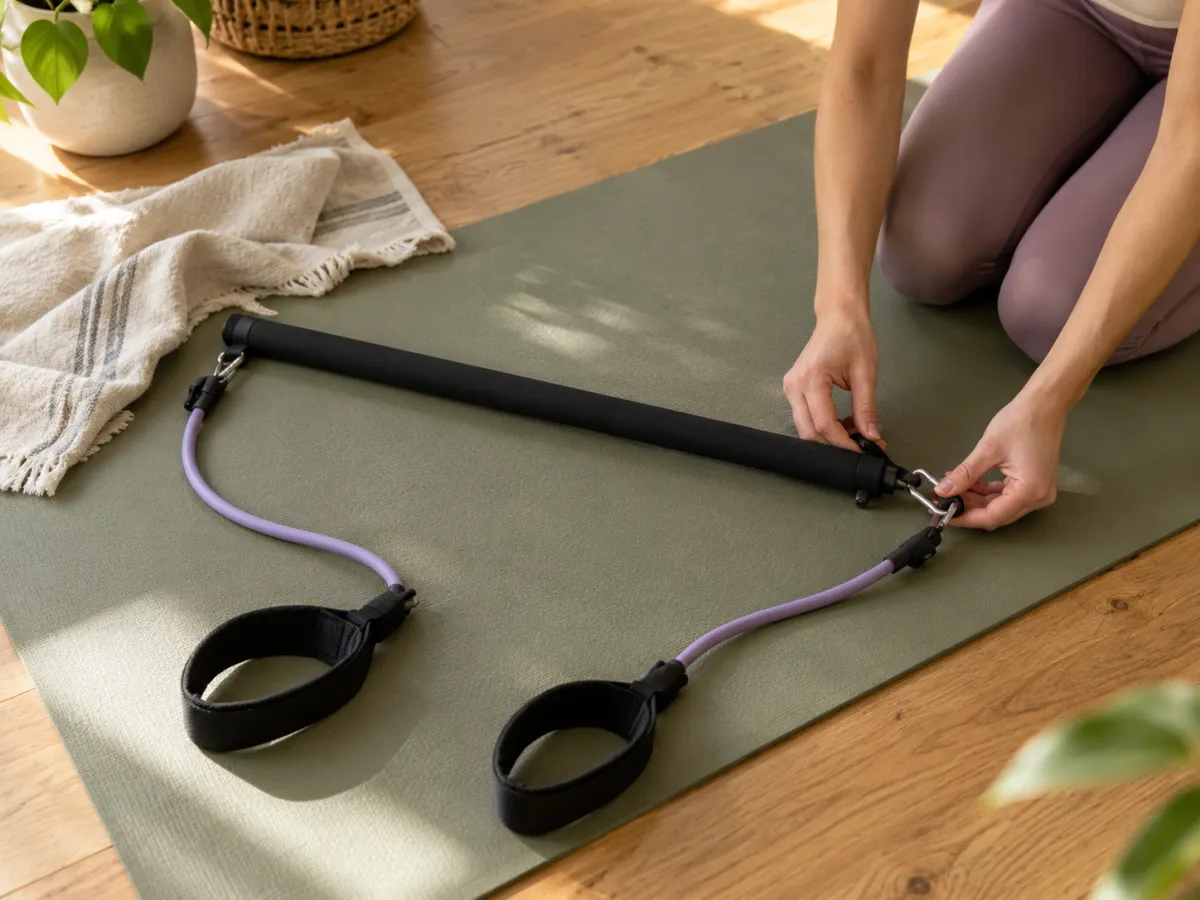
A well-sequenced Pilates bar workout translates the closed-chain tension of studio apparatus to a home mat by anchoring elastic resistance bands to your arches or hips while your hands or feet guide a rigid padded shaft. While a portable bar cannot replicate the gliding rail inertia of a wheeled Reformer carriage, it excels at providing continuous axial feedback, symmetrical limb spacing, and eccentric deceleration across supine footwork, spinal roll-downs, and standing lower-body flows.
According to the PilatesFits catalog listing, the Pilates Bars & Kits collection covers detachable Pilates bars and kits with resistance bands, compared by assembled length, included accessories, and resistance options.
How Pilates Bar Workout Translates Reformer Mechanics to the Floor
Understanding what a portable bar replicates—and what it alters biomechanically—is essential before programming Pilates bar exercises at home. On a studio Reformer, coiled steel springs resist a moving horizontal platform while your torso or feet press against fixed shoulder blocks and a stationary footbar. With a portable Pilates bar, your body and the mat form the stationary base, and the bar acts as a movable footbar or push-through bar connected via elastic cords.
First, notice resistance curve behavior. Elastic resistance bands generate linear-to-progressive tension: the further you press the bar away from the anchor point, the stronger the recoil pull becomes. That makes the eccentric (return) phase of every press or roll-up the highest-value portion of the movement. Instead of letting the bands snap your limbs back to the starting position, resist the return to engage deep lumbopelvic stabilizers and eccentric hamstring or abdominal fibers.
Second, leverage rigid shaft alignment feedback. Unlike loose loop bands that allow one arm or leg to drift laterally, a rigid bar couples your left and right sides together. During supine leg extensions or overhead shoulder flexion, any asymmetry in hip extension or scapular upward rotation immediately tilts the bar—giving you instant visual and proprioceptive feedback to square your pelvis and ribcage.
Third, respect progressive overload requirements. As Reddit Pilates practitioners frequently highlight, a basic step-on bar with a single light elastic cord works well for learning postural patterning, but once that baseline tension feels easy, simply adding repetitions yields diminishing strength returns. Using a modular kit with carabiner-clipped stackable bands allows you to match heavier cord combinations to strong lower-body presses and lighter cords to delicate scapular and core articulation.
Step-by-Step Pilates Bar Exercises At Home Sequence: Core, Glutes & Spinal Articulation
Use the five-movement comparison and execution table below to structure a balanced home flow that translates studio Reformer exercises to the mat:
| Home Pilates Bar Exercise | Studio Reformer Equivalent | Anchor & Bar Setup | Primary Alignment & Breathing Cue | Recommended Tempo & Progression |
|---|---|---|---|---|
| Supine Double-Leg Press | Reformer Footwork (Parallel & V-Position) | Foot straps over arches, bar held anchored at hips or chest | Exhale to press heels out on a diagonal while keeping lower ribs heavy on the mat | Controlled extension with a paused eccentric bend; clip heavier bands for glute loading |
| Seated Articulated Roll-Down | Reformer Short Box Round Back & Tower Roll-Back | Arches in foot loops, knees softly bent, hands gripping bar shoulder-width | Exhale to scoop the pelvis and articulate vertebra by vertebra without shrugging shoulders | Slow spinal flexion down, inhale at the hover point, exhale to curl up smoothly |
| Supine Teaser Prep with Bar | Reformer Teaser with Straps | Foot straps on arches, legs in tabletop, hands holding bar above shins | Maintain band tension between feet and hands to assist thoracic curl without neck strain | Smooth lift on the exhale, controlled lower on the inhale; reduce band assistance to progress |
| Quadruped Unilateral Glute Press | Reformer Kneeling Eve’s Lunge / Scooter | Hands pinning bar on mat under shoulders, one foot looped in active band | Keep pelvis level and lumbar spine neutral as the working heel presses toward the ceiling | Steady outward press and slow return; avoid overarching the lower back at full extension |
| Standing Rowing & Chest Expansion | Reformer Rowing Back & Chest Expansion | Standing on foot straps, bar held in front of thighs with palms facing back | Draw shoulder blades wide and down before pressing the bar slightly behind the hip line | Pause at peak scapular retraction while turning the head side to side with an upright sternum |
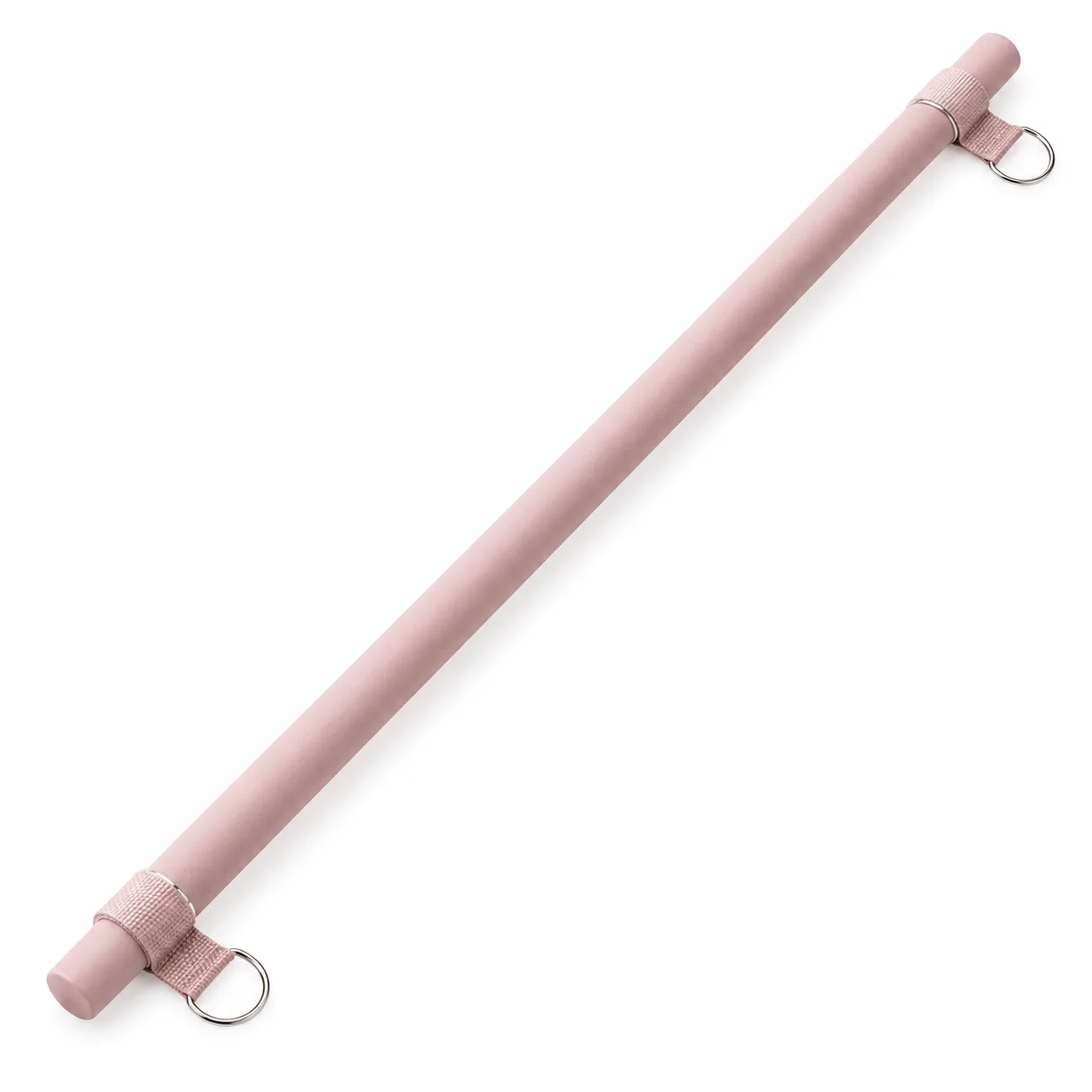
Setup Boundaries and Progression Rules Without a Studio Machine
To get consistent studio-quality feedback from equipment in the PilatesFits Pilates Bar collection, apply these four floor setup and progression rules during your home sessions:
- Eliminate dead-zone cord slack before starting a set: Because elastic cords only create work once stretched past their resting length, adjust the nylon foot-strap buckles or step wider so the bands hold light baseline tension at the very bottom of the movement. Never wrap raw latex cords tightly around metal connector joints to shorten them, as friction against steel edges accelerates cord wear.
- Scale tension between upper- and lower-body blocks: Your glutes and quadriceps require substantially more resistance than your rotator cuff and deep neck flexors. Unclip a band when transitioning from supine footwork into seated arm work or spine twist variations so you do not compensate by hiking your upper traps.
- Anchor foot straps securely across the midfoot arch: Whether practicing barefoot or in grip socks, center the strap across the longitudinal arch rather than near the toes so the loop cannot slip upward during overhead or diagonal leg presses.
- Combine standalone bands for unilateral warm-ups: Before beginning bilateral bar movements, use flat loops or figure-8 cords from the Pilates Resistance Bands collection to wake up external hip rotators and serratus anterior stabilizers.
Frequently Asked Questions
How do portable 3-section Pilates bar kits work, and what resistance features prevent plateauing once the base band feels easy?
A portable multi-section Pilates bar connects into a rigid padded shaft with elastic resistance bands clipped to rotating end-caps and foot straps. By anchoring the straps under your feet or hands and pressing the bar with the opposite limbs, you create closed-chain resistance across the core, hips, and shoulders. To prevent plateauing once the initial band feels easy, select a kit with interchangeable or stackable carabiner bands so you can increase tension rather than only adding repetitions.
Can a Pilates bar workout replace a studio Reformer workout at home?
A Pilates bar workout cannot fully replace the rolling carriage mechanics, adjustable springbed angles, or heavy spring loads of a commercial studio Reformer. However, a modular multi-band bar kit effectively replicates closed-chain footwork, assisted spinal articulation, and bilateral alignment feedback on a home mat at a fraction of the footprint.
How do you structure a balanced Pilates bar exercises at home routine for core and lower body?
Start with supine double-leg presses and articulated roll-downs to warm up lumbo-pelvic stability and spinal flexion, move into quadruped glute presses and standing squats with heavier stacked bands for lower-body strength, and finish with lighter-tension seated spine twists and chest expansion to reinforce upright posture.
Make it part of your practice
Explore the purple pilates bar with resistance cords and check its product details before choosing your studio essentials.
View this piece