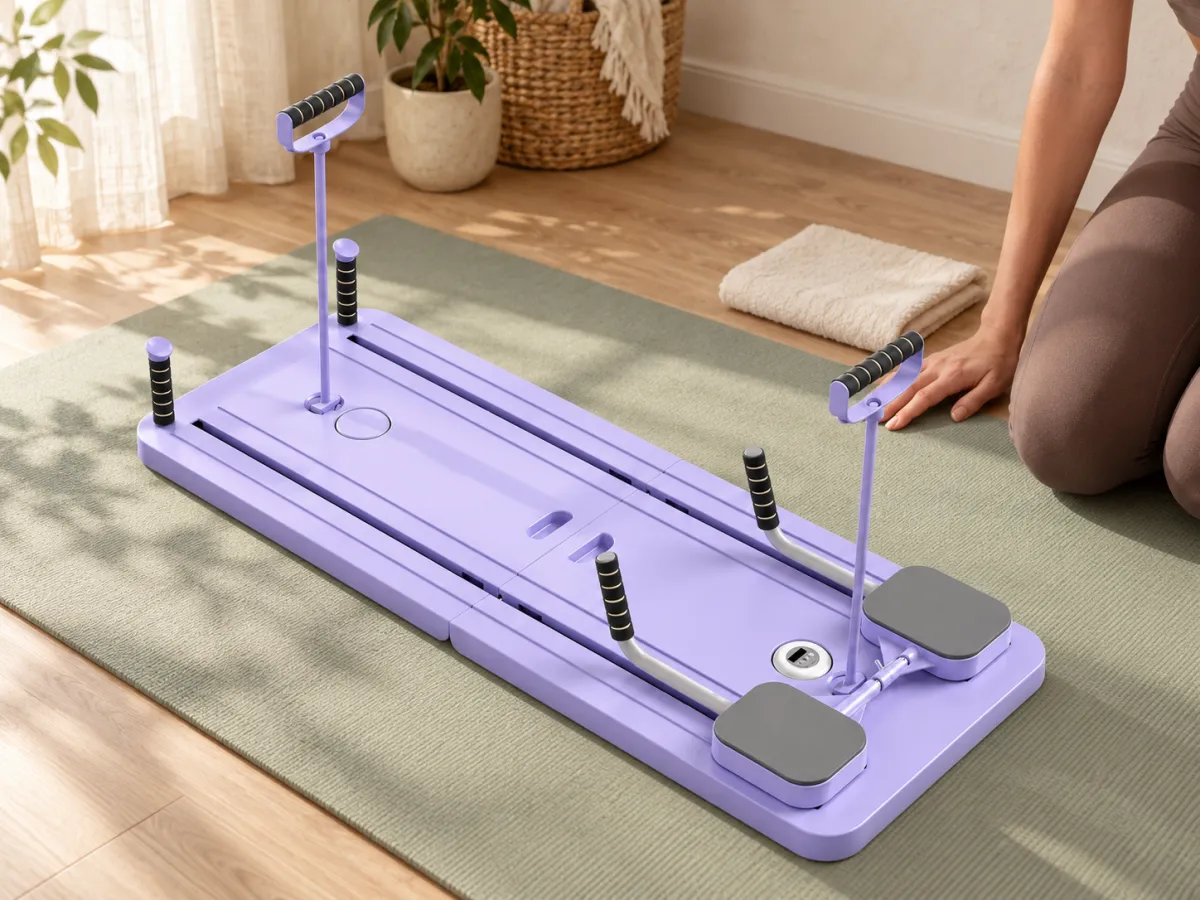
Asking “does Pilates board work” and reading a detailed Pilates board review comes down to how effectively you control pelvic tilt, ribcage closure, and sliding carriage momentum on a compact floor track. Portable and foldable Pilates boards combine a linear ab-roller glide track, push-up grips, and elastic resistance cords to challenge your deep core stabilizers at home—provided you set the board on a flat, hard surface and avoid the hip-flexor and lumbar compensations that shorten muscle time under tension.
According to the PilatesFits catalog listing, the Pilates Boards collection features portable and foldable Pilates boards for home workouts, with product dimensions, included accessories, and use instructions available before orders open.
The Biomechanics Behind Does Pilates Board Work in Mat and Reformer Movements
To understand why a Pilates board works for targeted core and upper-body conditioning—and where its honest mechanical boundaries lie compared to a full studio machine—it helps to break down three biomechanical principles.
First, examine closed-chain anti-extension core loading. When your knees or hands rest on the sliding platform of a foldable Pilates board, extending the glide carriage forward increases the lever arm between your shoulders and pelvis. Your transverse abdominis, rectus abdominis, and serratus anterior must fire eccentrically to prevent your lumbar spine from sagging toward the floor. Unlike a full-size studio Reformer with a long wheeled carriage and heavy adjustable steel springs, a portable board operates over a more compact linear track and uses elastic cord assistance or resistance, making slow tempo control essential.
Second, consider ribcage-to-pelvis connection during return glide. Many home users let the board’s rebound or elastic cords pull their knees back automatically. True Pilates muscle recruitment happens when you initiate the return by drawing your lower ribs toward your anterior superior iliac spines, hollowing the abdominals rather than yanking with the hip flexors.
Third, respect subfloor stability and wrist-shoulder stacking. Because a foldable hinge board sits directly on the floor, placing it over plush carpet allows the center seam to flex and the track to bind. Practicing on flat hardwood, tile, or a firm low-pile surface keeps the glide rails level and protects your wrists and shoulders during plank pikes and push-up variations.
3 Common Mistakes With Pilates Board Review and How to Fix Each One
Use the five-row biomechanical troubleshooting matrix below to diagnose and fix the most frequent alignment errors reported in any thorough Pilates board review:
| Common Pilates Board Form Mistake | What Happens Mechanically | Joint or Muscle Compensation Risk | Immediate Tactile & Alignment Fix | How to Verify Correct Muscle Recruitment |
|---|---|---|---|---|
| Over-extending the kneeling rollout past ribcage control | Anterior pelvic tilt and lumbar hyperextension as the carriage reaches the end of the track | Lower-back compression and disengaged deep abdominal wall | Stop the forward glide the instant your lower ribs flare; exhale to knit ribs to hips before returning | Feel sustained tension across the mid-abdominals with zero pinching in the lumbar spine |
| Rushing the return phase using elastic cord bounce | Momentum and psoas pull replace eccentric and concentric abdominal braking | Hip-flexor fatigue and minimal transverse abdominis time under tension | Count three full seconds on the outward slide and three full seconds on the return, pausing briefly at peak extension | Movement stays silent and smooth without the carriage clacking against the end stops |
| Placing a foldable board on thick carpet or uneven rugs | Center hinge flexes downward under kneeling body weight, pinching the linear glide channel | Jerky track resistance and uneven wrist or knee loading | Set the board exclusively on flat hardwood, tile, or a firm, level floor surface | Carriage glides smoothly from end to end with uniform resistance under both knees |
| Collapsing into the wrists and shrugging the upper traps in plank pikes | Scapulae elevate toward the ears and weight dumps into the heels of the palms | Wrist joint strain and neck tension during upper-body and core slides | Grip the push-up handles with neutral wrists, press the floor away to protract the shoulder blades, and lengthen the crown of the head | Serratus anterior and lats stay active while the neck and wrists remain comfortable |
| Pulling resistance cords with bent wrists and flaring elbows | Forearms absorb the elastic load instead of the posterior deltoids, rhomboids, and core | Elbow tendon irritation and loss of thoracic posture during kneeling rows | Lock wrists neutral, draw shoulder blades down and back, and exhale as you row or press the handles | Upper back and deep core brace together without torso swaying backward |
Self-Check Alignment Protocol Before Your Next Session
Before starting your next workout on a board from the PilatesFits Pilates Board collection, run through this 60-second setup and form verification checklist:
- Confirm a flat, rigid floor surface and review product instructions: Because dimensions, included accessories, and use instructions are provided per product in the collection, check your board’s setup guide and verify that the unfolded frame sits completely flat on hardwood or tile before kneeling.
- Set your range-of-motion stop before adding speed: Perform three slow test glides to find the exact point where your neutral pelvis and closed ribcage stay stable, treating that distance as your working stroke limit.
- Pair with floor sliders for multi-planar range when needed: Because a portable board moves along a fixed linear track, pair your routine with discs from the Pilates Sliders collection when you want wide circular lunges, lateral skating arcs, or multi-directional hip mobility off the track.
- Anchor your breath to the three-second tempo rule: Inhale as you lengthen the carriage out under control, and exhale completely through pursed lips as you draw the carriage home from your powerhouse.
Frequently Asked Questions
Does a foldable portable Pilates board work for home workouts, and how does it differ from a studio Reformer?
Yes—a portable and foldable Pilates board works well for compact home core slides, kneeling plank pikes, push-up variations, and upper-body resistance cord exercises without giving up living room space to a full Reformer. However, its sliding track travel and elastic resistance are more compact than a commercial studio Reformer, which uses a full-length wheeled carriage and adjustable metal springs.
What is the most common mistake people make with does pilates board work?
The most common mistake is sliding out too far and too fast while letting the lower back arch, or placing a foldable board on plush carpet where the hinge flexes. Shortening your rollout range to match your rib-to-hip control and practicing on a flat, hard floor immediately restores deep abdominal engagement.
How does pilates board review affect alignment and muscle activation in Pilates?
Evaluating a Pilates board through a biomechanical lens highlights how track smoothness, handle placement, and elastic cord angles influence your posture: when you keep your wrists neutral, ribs knitted, and tempo slow over the compact track, your transverse abdominis, obliques, and shoulder stabilizers perform the work rather than momentum.
Make it part of your practice
Explore the lavender pilates training board with handles and check its product details before choosing your studio essentials.
View this piece