


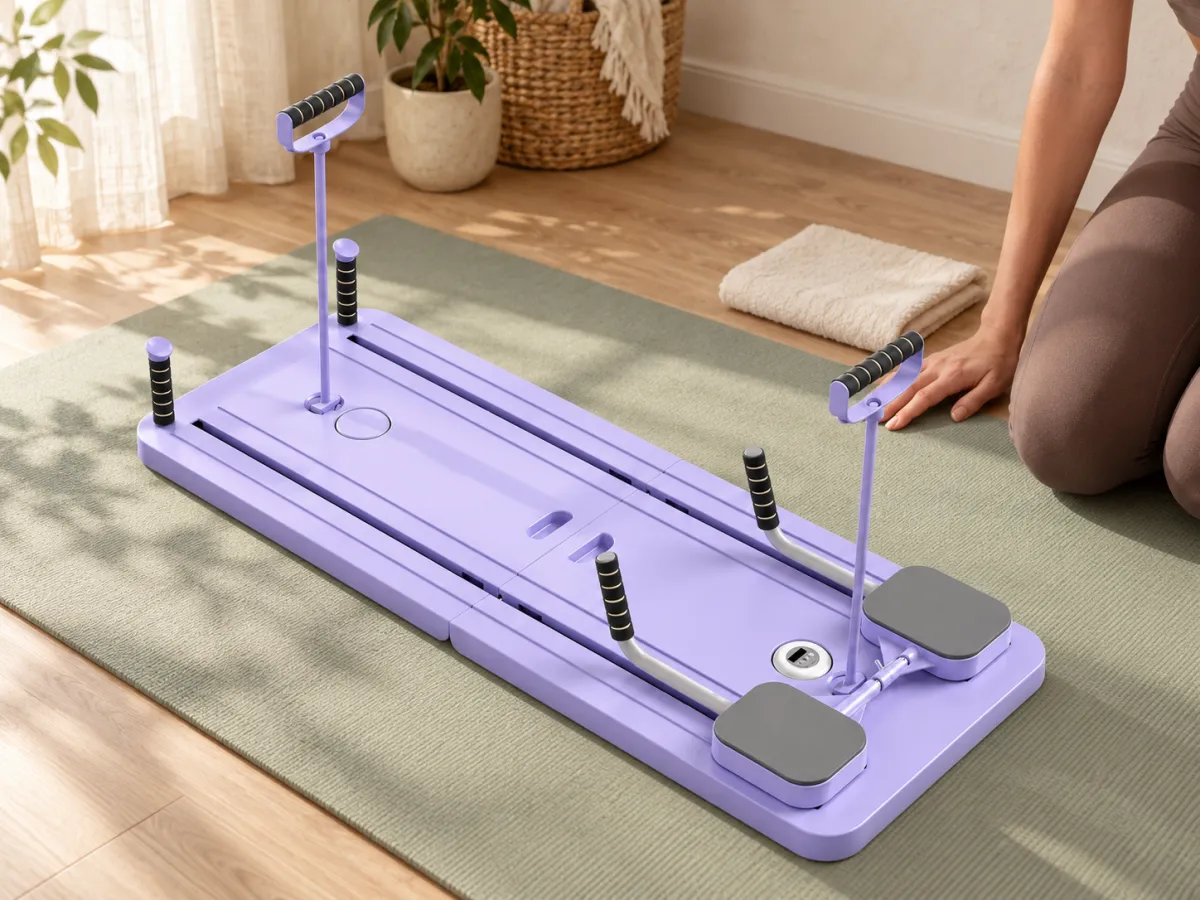
Using a foldable pilates board on carpet vs hardwood changes both the static friction under the base frame and the torsional stress across the central folding hinge. On sealed hardwood, the primary challenge is preventing lateral drift when horizontal shear forces peak during long-lever core extensions or unilateral band rows; on plush or medium-pile carpet, the challenge shifts from sliding to uneven frame compression, where pile sinkage tilts the linear guide rails and causes the sliding carriage wheels to bind against the track walls. Knowing how to keep pilates board from sliding while protecting the base elastomers, polymer tracks, and resistance cords from premature wear ensures consistent carriage glide and reliable floor grip across every session.
According to the PilatesFits catalog listing, the Pilates Boards collection features portable and foldable Pilates boards for home workouts, with product dimensions, included accessories, and use instructions available before orders open.
How Floor Surfaces Affect a Foldable Pilates Board: Carpet vs. Hardwood Mechanics
A portable foldable Pilates board relies on two distinct mechanical interfaces: the bottom anti-slip elastomer pads that anchor the chassis to your floor, and the internal linear track where polymer rollers travel under bodyweight load. Unlike a commercial studio Reformer—which uses a heavy frame and metal springs over a long carriage stroke—a compact home Pilates board has a shorter sliding track and relies on elastic resistance cords combined with user bodyweight to stay planted.
When you set up a foldable pilates board on carpet vs hardwood, the floor substrate dictates how load transfers through the center hinge:
- Hardwood, bamboo, and luxury vinyl plank (LVP): Rigid, non-porous surfaces offer uniform vertical support under both halves of the folding chassis, keeping the left and right track rails coplanar. However, household dust, silicone floor polishes, and dried sweat form a microscopic boundary layer on the thermoplastic elastomer (TPE) or silicone base feet, dropping the coefficient of static friction just when you push horizontally away from the anchor point.
- Low-pile commercial or woven rugs: Dense, flat-weave rugs provide moderate mechanical interlocking against the board’s base pads without excessive vertical deflection, provided the rug itself is anchored by a high-grip underlayment.
- Medium-to-high-pile residential carpet: Soft carpet fibers compress unevenly beneath your knees or hands where vertical load concentrates. This localized depression flexes the center folding pin, slightly pinching the internal slider channel and increasing roller friction against the side walls of the track.
| Floor Surface & Setup | Static Traction & Shear Stability | Hinge & Track Alignment Impact | Material Wear & Contamination Risk | Recommended Stabilization & Care Protocol |
|---|---|---|---|---|
| Sealed Hardwood / Engineered Wood | High initial grip when clean; drops sharply if floor wax or fine dust coats the base pads | Optimal coplanar rail support; zero hinge flex under kneeling or plank loads | Micro-grit abrasion on base TPE feet and track rollers if floor is not dust-mopped first | Wipe floor and base pads with a damp microfiber cloth before every session; avoid oil-based floor cleaners |
| Luxury Vinyl Plank (LVP) / Laminate | Moderate-to-high traction; textured embossing can reduce contact surface area of flat rubber feet | Stable vertical support across the folding joint | Surfactant residue from wet-mopping leaves a slick film on silicone grip pads | Degrease base pads weekly with mild castile soap solution and dry completely before unfolding |
| Low-Pile Flat-Weave Carpet | Resists horizontal sliding via surface texture, unless the rug shifts on the subfloor | Minimal rail deflection; slight cushioning under the hinge knuckles | Loose synthetic fibers migrate into the roller bearings and linear track channels | Vacuum the track channel before folding; place a thin high-density mat beneath if the rug creeps |
| Medium-to-Plush Residential Carpet | High resistance to lateral sliding, but unstable rotational pitch under single-side loading | High hinge torque; uneven pile compression causes the center joint to bow downward | Carpet lint and dander pack around wheel axles, increasing rolling resistance | Place a rigid plywood sub-board or dense exercise mat under the chassis to bridge carpet pile |
| Dense Exercise Mat Over Hardwood | Highest shear lock when both mat surfaces are clean and dry | Uniform load distribution with slight vibration damping | Plasticizer migration if PVC mats remain pressed against TPE feet in warm storage | Separate the board from the mat after training; store folded in a cool, shaded closet |
How to Keep a Pilates Board From Sliding During High-Shear Exercises
When practitioners search for ways to keep pilates board from sliding, the issue usually appears during two movement phases: the eccentric rollout of a kneeling core pike or ab-wheel extension (where forward horizontal force pushes the board away from the knees), and standing or seated resistance band pulls (where upward and diagonal cord tension lifts the front edge of the lightweight chassis).
- Eliminate the dust-and-lipid film on base grip pads: Even a thin layer of skin oils, pet dander, or dry floor dust reduces elastomer friction on hardwood by acting like microscopic ball bearings. Before unfolding the board, wipe both the floor footprint and the bottom rubberized contact pads with a lightly dampened microfiber towel and let them air-dry for sixty seconds.
- Keep vertical load centered over the chassis: Because a portable foldable board is lightweight compared to a studio machine, pulling the resistance bands at a steep horizontal angle without counter-weighting the deck will tug the frame across smooth floors. Anchor at least one knee, foot, or hand directly onto the board’s main platform or integrated kneeling pad whenever pulling the elastic cords.
- Bridge soft carpet with a high-durometer base layer: If your workout space has plush carpeting, do not place the folding hinge directly on deep pile. Lay a high-density closed-cell mat or a flat rigid platform over the carpet first so the center hinge locks flat and every base pad makes simultaneous contact.
- Control eccentric turnaround speed: Abruptly bouncing out of the end range of the sliding track sends an impulse shock into the frame bumper, breaking static traction on smooth wood floors. Decelerate smoothly before the slider reaches the mechanical stop.
If you want to compare compact track boards or add dedicated floor accessories to your home setup, browse the PilatesFits Pilates Boards collection alongside complementary low-friction Pilates sliders for floor conditioning.
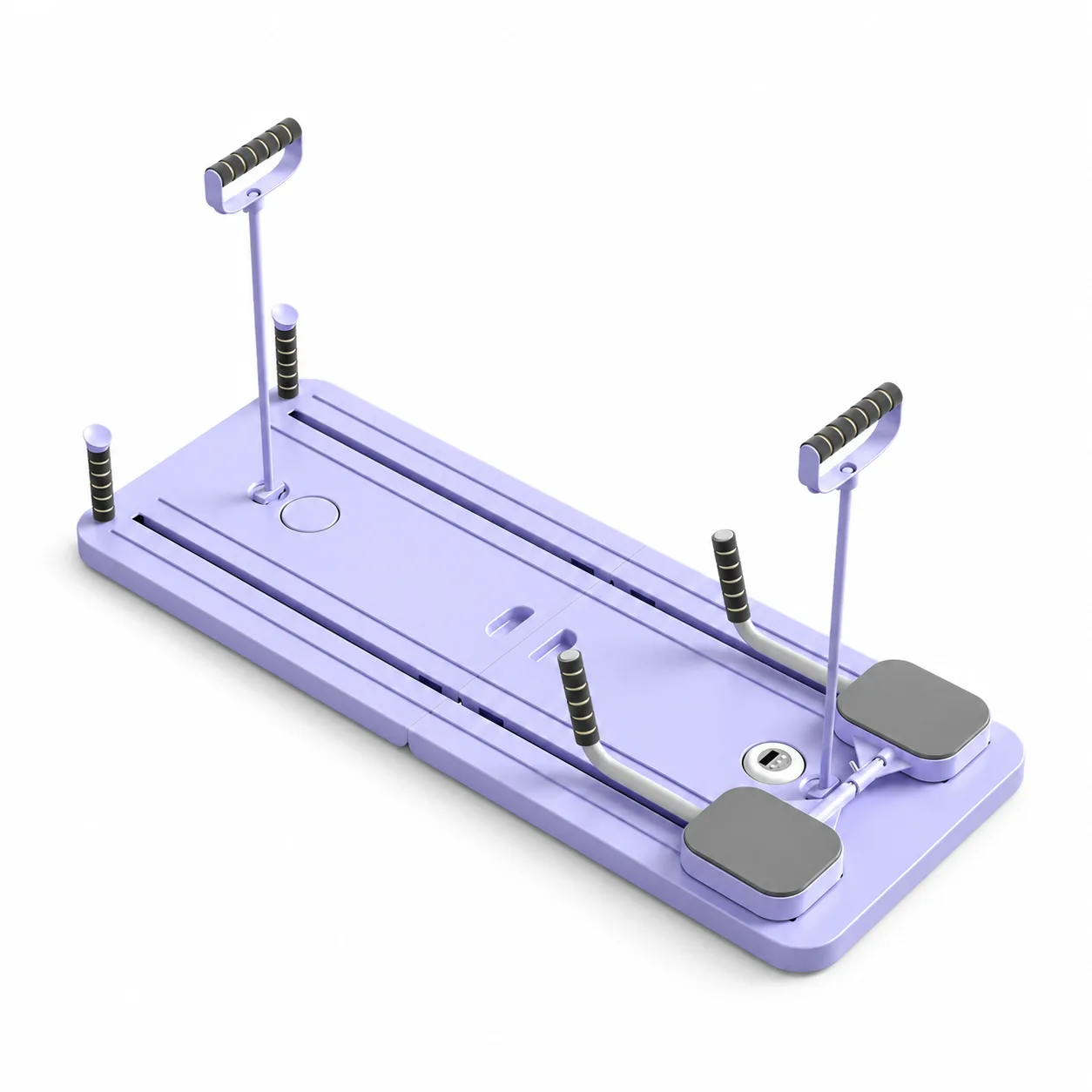
What Degrades Pilates Board Materials: Sweat, Detergents, Floor Grit, and UV Exposure
Extending the lifespan of a foldable Pilates board requires protecting four distinct material groups: the structural polymer deck (typically ABS or reinforced polypropylene), the high-friction TPE or silicone base pads, the EVA or nitrile foam kneeling and push-up grips, and the natural latex or thermoplastic elastomer resistance cords.
- Alkaline household degreasers and bleach: Harsh kitchen sprays, ammonia, and bleach strip plasticizers from TPE anti-slip feet, turning tacky grip pads hard, glazed, and slippery on hardwood.
- Silicone furniture sprays and floor waxes: Using wood polish near your workout zone transfers dimethylpolysiloxane onto the board’s underside. Once silicone oil bonds to elastomer feet, water alone cannot remove it, and the board will slide unpredictably.
- Carpet lint and abrasive silica grit: When a board is used on carpet or unswept hardwood, hair and grit collect inside the recessed linear glide tracks. Under bodyweight load, trapped grit scores the polymer rail walls and flattens the roller wheels, creating a jerky, noisy stroke.
- UV radiation and radiator heat: Leaving a folded Pilates board in direct window sunlight or leaning against a baseboard heater accelerates photo-oxidation in the elastic resistance bands and dries out closed-cell foam pads.
Step-by-Step Cleaning and Sanitization Protocol for Carpet and Hardwood Users
Follow this post-session and weekly maintenance routine to preserve both internal track glide and bottom-surface traction:
1. Dry Track Clearing After Every Carpet Session
Before folding the board, tip it on its side or use a soft-bristle brush attachment to sweep any carpet fibers, dust, or hair out of the linear slider grooves. Check the underside of the moving carriage rollers to ensure threads have not wrapped around the wheel axles.
2. Two-Cloth Wipe-Down for Deck, Grips, and Base Pads
Mix a few drops of pH-neutral mild dish soap or castile soap in warm water. Use one damp microfiber cloth to wipe sweat salts from the push-up handles, EVA kneeling pad, and top deck. Use a second clean damp cloth exclusively for the bottom anti-slip feet so you never transfer body oils from the handles onto the floor-contact pads. Follow immediately with a dry towel.
3. Restoring Glazed Base Pads for Hardwood Grip
If the bottom rubberized pads begin to feel slick on hardwood, wash them with warm water and mild dish soap, rub briskly with a textured terry towel to lift embedded floor wax or dust, and rinse with plain water. Never apply alcohol, acetone, or essential-oil mat sprays to the base feet or elastic resistance tubes.
Storage, Hinge Inspection, and Replacement Signs
Always detach the push-up handles and unclip or untangle the resistance bands before folding the board so the cords are never pinched inside the clamshell hinge. Store the folded board flat under a bed or upright in a closet where temperatures stay moderate and dry.
Before each weekly workout, inspect three wear points:
- Elastic resistance cords: Stretch each tube in good light and check near the carabiner or handle anchor plugs for chalky white stress marks, surface crazing, or nicked walls. Replace any cord showing micro-tears immediately.
- Center folding hinge and lock pins: Verify that the hinge knuckles sit flush when opened on a flat hardwood floor and that no plastic stress whitening appears around the pivot pin.
- Roller wheels and track bumpers: Slide the carriage unloaded from end to end; if you feel flat spots, grinding, or loose axle play, clean the channel or retire worn rollers before loading full bodyweight.
Frequently Asked Questions
Does a foldable Pilates board work for home core and resistance workouts, and what are its limits compared to a studio Reformer?
Portable and foldable Pilates boards combine sliding ab-roller tracks, push-up grips, and resistance bands for compact home workouts without giving up living space to a full Reformer, though their track travel and elastic resistance are more compact than a studio Reformer. Because they use a shorter linear track and elastic cords rather than full-length metal springs, they excel at high-tension core pikes, planks, and band-assisted conditioning in small spaces.
What is the safest way to handle a foldable Pilates board on carpet vs. hardwood without damaging the material?
On hardwood, dust-mop the floor and wipe the board’s bottom elastomer pads with a damp microfiber cloth before every session so fine grit does not abrade the grip feet or cause lateral sliding. On medium- or high-pile carpet, place a firm, high-density exercise mat or rigid sub-base underneath the board to prevent the center folding hinge from bowing downward under kneeling loads.
How often should you perform maintenance to keep a Pilates board from sliding?
Wipe the bottom traction pads and clear the linear glide tracks after every one to two workouts, and perform a deeper degreasing wash on the rubberized base feet once a week using warm water and a drop of pH-neutral soap. Keeping the base pads free of dust and floor polish residue is the single most reliable way to maintain static friction on smooth floors.
Make it part of your practice
Explore the charcoal folding pilates board and check its product details before choosing your studio essentials.
View this piece