


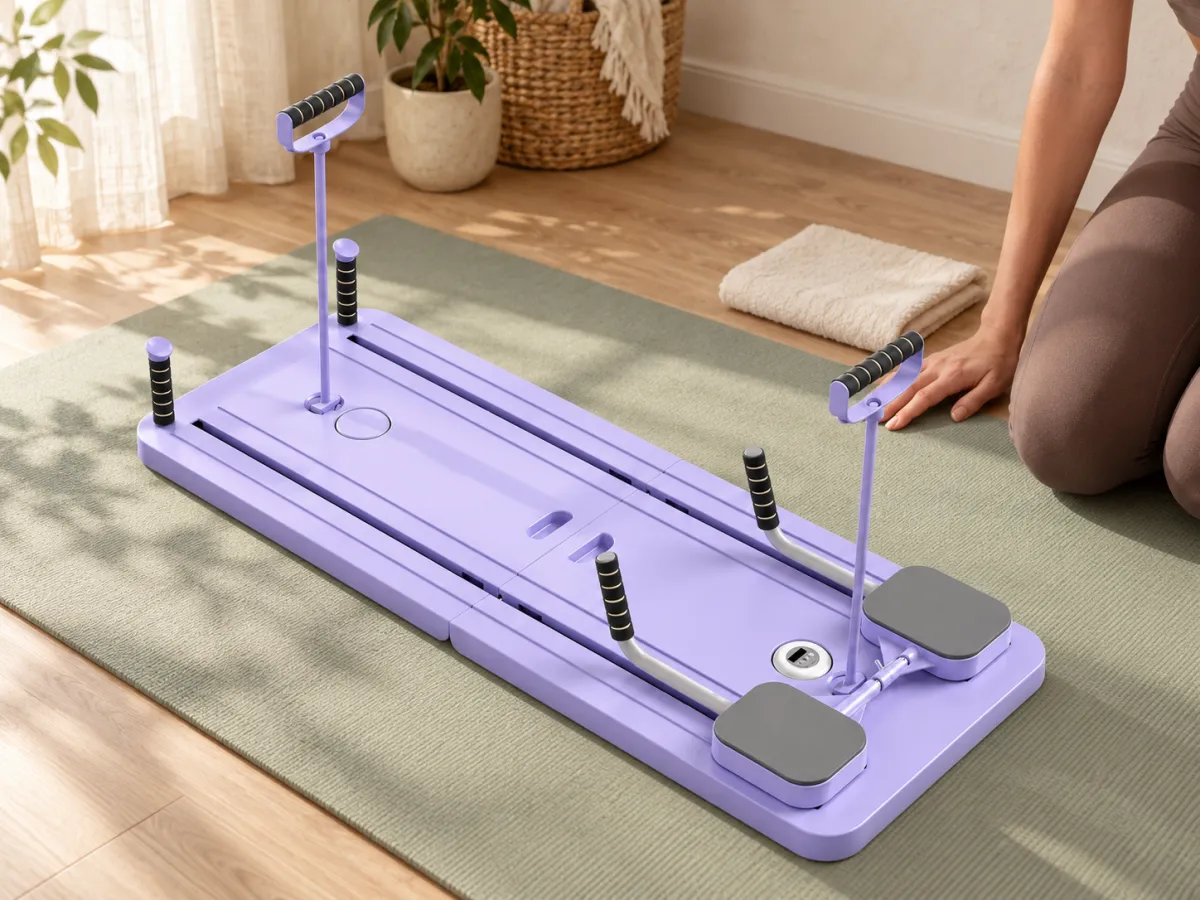
Structuring an effective pilates board ab workout requires understanding how a linear sliding track changes anterior core recruitment compared to floor mat crunches or a full studio Reformer. When you perform kneeling core pikes on pilates board tracks, your hands or forearms anchor onto the fixed deck while your knees ride the moving carriage—or vice versa—forcing your transverse abdominis, rectus abdominis, and serratus anterior to control both eccentric spinal extension resistance and concentric hip flexion. Because a compact home board uses a shorter linear stroke and elastic resistance cords rather than full-length metal Reformer springs, pairing the board with small props and precise tempo shifts allows you to build progressive trunk endurance without cluttering your floor space.
According to the PilatesFits catalog listing, the Pilates Boards collection features portable and foldable Pilates boards for home workouts, with product dimensions, included accessories, and use instructions available before orders open.
How a Pilates Board Ab Workout Fits Into a Complete Pilates Training System
A portable foldable Pilates board bridges the gap between open-chain mat work and studio carriage training. On a flat mat, exercises like the Roll-Up or Criss-Cross rely entirely on gravity acting against torso mass. On a sliding Pilates board, the moving roller carriage introduces horizontal shear instability: the moment your knees or hands leave the neutral vertical stack, your deep trunk stabilizers must decelerate the slider before it reaches the end stop of the track.
At the same time, practitioners should respect the mechanical boundaries of a compact board:
- Shorter linear track travel: Unlike a studio Reformer carriage that accommodates full-body supine leg extensions and long-stroke elephant pikes, a foldable home board concentrates its travel range into high-tension kneeling, plank, and seated angles.
- Elastic cord tension vs. metal coil springs: Included resistance bands increase tension progressively as they stretch away from the base anchors, making them ideal for pairing anti-rotation upper-body presses with isometric core holds.
- Multi-prop synergy: Adding a soft mini stability ball between the inner thighs or placing low-friction floor sliders beneath the non-track limbs recruits the adductor-pelvic-floor-oblique sling without requiring heavy machinery.
| Exercise & Prop Pairing | Primary Core & Stabilizer Target | Track Direction & Resistance Setup | Key Biomechanical Alignment Cue | Progression Lever |
|---|---|---|---|---|
| Kneeling Ab Rollout (Board Only) | Anterior core wall (rectus abdominis, transverse abdominis) and latissimus dorsi | Knees on sliding pad; hands on fixed push-up grips; light or unloaded track | Keep ribs knitted toward the pubic symphysis; stop forward glide before lumbar hyperextension occurs | Add a 3-second eccentric lower and a 2-second pause at peak shoulder flexion |
| Kneeling Core Pikes on Pilates Board | Lower abdominal flexors, serratus anterior, and deep hip flexors | Hands on fixed front handles; knees on sliding carriage; exhale to draw knees under hips | Push the floor away through the scapulae to dome the upper back slightly as the pelvis lifts | Squeeze a small Pilates ball or yoga block between the inner thighs to engage the deep midline |
| Oblique Carriage Knee Tucks | Internal and external obliques, rotational trunk stabilizers | Hands anchored on fixed grips; knees rotated 30 degrees together on the sliding pad | Keep both shoulders square over the wrists while drawing both knees toward the opposite elbow | Hold an isometric tuck at the top of the stroke for two full breath cycles |
| Seated Resistance Band Torso Twist + C-Curve | Transverse abdominis, multifidus, and scapular retractors | Seated on the center deck Pad; holding elastic resistance handles at chest height | Posteriorly tilt the pelvis into a supported C-curve before rotating the ribcage as a single cylinder | Extend the lever by straightening the arms slightly forward while maintaining even band tension |
| Hybrid Plank Saw With Floor Sliders | Full anterior chain, gluteus medius, and shoulder girdle stabilizers | Forearms on the board’s sliding carriage; toes anchored on floor sliders behind the deck | Maintain a neutral plumb line from ear to ankle while gliding the forearms two inches forward and back | Alternate single-leg abductions on the rear floor slider while holding the front carriage still |
Progressive 3-Block Sequence: Pilates Board Ab Workout and Kneeling Core Pikes
To protect the lumbar spine and wrist joints, organize your pilates board ab workout into three progressive blocks: neuromuscular midline activation, peak eccentric-concentric control, and spinal decompression.
Block 1: Midline & Serratus Activation (4 Minutes)
Start in a quadruped hover with your hands gripping the fixed push-up handles and your knees resting on the sliding carriage pad directly beneath your hips. Inhale to widen the back of your ribcage; exhale to draw your navel toward your spine and glide the knees three inches backward without letting your lower back sag. Perform 8 slow micro-glides at a 3-1-3 tempo to wake up the serratus anterior and deep transverse abdominal corset before attempting longer levers.
Block 2: Peak Control — Kneeling Core Pikes on Pilates Board (8 Minutes)
Transition directly into kneeling core pikes on pilates board rails:
- Set your scapular anchor: Grip the front push-up handles or rest your forearms on the front deck pads. Press firmly downward so your shoulder blades protract slightly and your neck stays long.
- Initiate from the lower ribs and pubic bone: Rather than yanking with your hip flexors, exhale sharply andhollow your lower belly to draw the sliding knee carriage forward toward your wrists while lifting your tailbone toward the ceiling into a kneeling pike.
- Control the eccentric return: Inhale over three full counts as you lengthen the knees back out to a diagonal kneeling plank, stopping just short of the point where your anterior ribs flare toward the floor.
- Add oblique channeling: On your second set of 8 repetitions, angle your knees slightly toward the left wrist on odd reps and the right wrist on even reps to target the lateral abdominal wall.
If you are building out a versatile home training corner, explore the PilatesFits Pilates Boards collection and pair your board work with Pilates sliders for multi-planar core extensions.
Block 3: Band-Assisted C-Curve & Thoracic Decompression (4 Minutes)
Sit tall on the board’s padded deck facing the resistance band anchor points. Hold the band handles at sternum height, exhale to roll halfway back onto your sacrum, and perform 10 slow chest presses or alternating kayak rotations. Finish in a kneeling child’s pose with your hands resting on the forward carriage to lengthen the lats and thoracic spine.
How to Progress Challenge Week Over Week Without Buying Redundant Gear
Because a compact Pilates board has a fixed track length, sustainable progression comes from biomechanical leverage rather than piling on heavy hardware:
- Weeks 1–2 (Tempo & Range Mastery): Restrict carriage travel to the middle two-thirds of the linear track so you never rest on the front or rear mechanical bumpers. Use a 3-second eccentric phase on every rollout.
- Weeks 3–4 (Midline Adduction Pairing): Place a rolled hand towel or small Pilates ball between your knees during kneeling core pikes on pilates board sets. Squeezing the midline increases pelvic floor and deep oblique co-contraction by eliminating knee splay.
- Weeks 5–6 (Combined Cord + Carriage Loading): Hold one resistance band handle in your free hand during unilateral kneeling planks on the board, combining anti-rotation band tension with carriage stabilization.
Frequently Asked Questions
Does a foldable Pilates board work for home core and resistance workouts, and what are its limits compared to a studio Reformer?
Portable and foldable Pilates boards combine sliding ab-roller tracks, push-up grips, and resistance bands for compact home workouts without giving up living space to a full Reformer, though their track travel and elastic resistance are more compact than a studio Reformer. They are highly effective for concentrated anterior core conditioning, kneeling pikes, and band-resisted upper-body work in apartments or shared rooms.
How do you combine a Pilates board ab workout with other Pilates props or outfits?
Pair your Pilates board with a small adduction prop—such as a soft Pilates ball or foam block between the knees—to deepen pelvic floor and oblique engagement during sliding pikes, or place floor sliders under your feet for long-lever plank saws. Wear form-fitting, high-waisted grip socks and breathable studio apparel so loose fabric never catches inside the linear roller channels.
What is the best way to progress kneeling core pikes on a Pilates board once basic movements feel easy?
Slow your eccentric return to four full seconds, eliminate any pause at the bottom bumper, and add a two-second isometric peak hold at the top of each pike where your ribs and hips fold together. You can also transition from two-knee pikes to single-knee hovering pikes or pair the movement with unilateral resistance band holds.
Make it part of your practice
Explore the lavender pilates training board with handles and check its product details before choosing your studio essentials.
View this piece