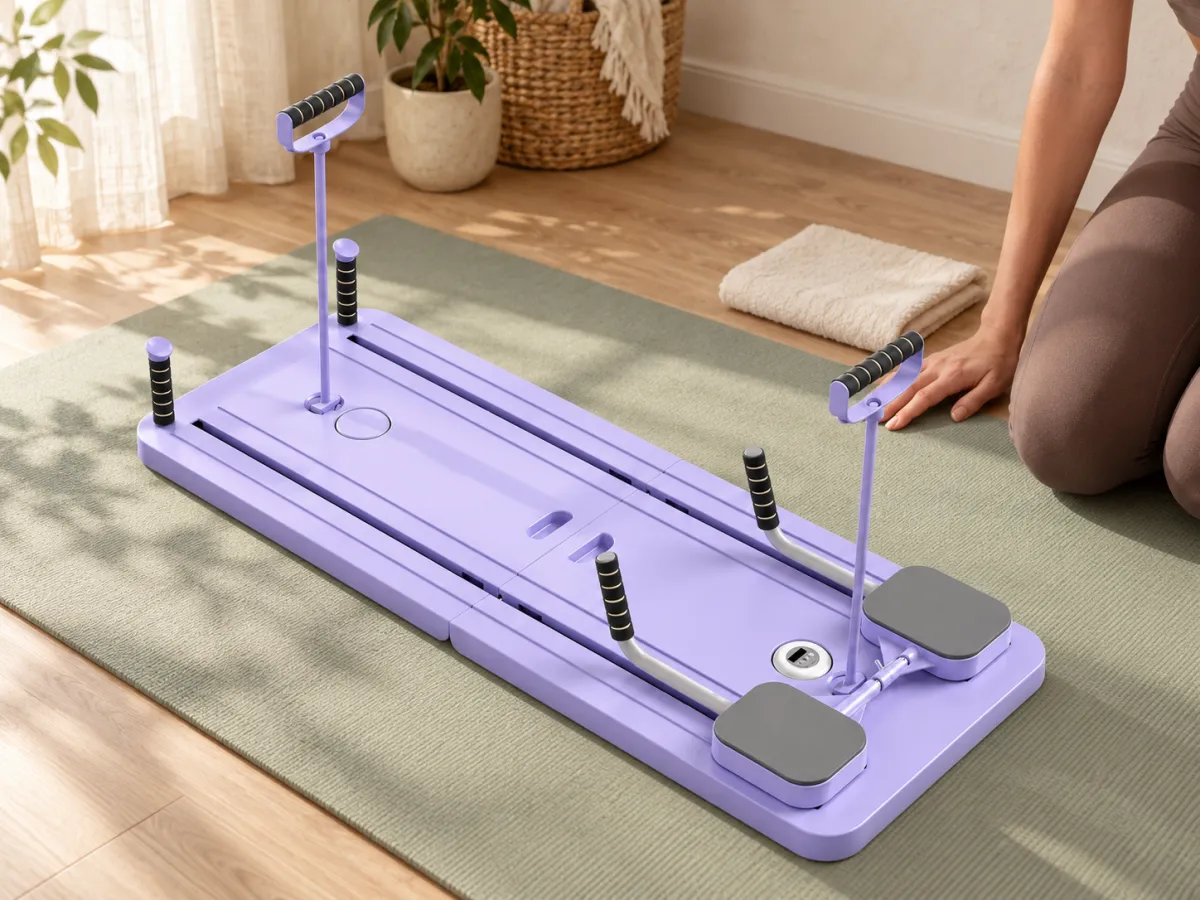
Evaluating a pilates board for apartment or home studio training requires inspecting linear track smoothness, elastic rebound mechanics, and hinge rigidity on a foldable pilates reformer board before you buy. While compact sliding boards deliver high-tension abdominal rollouts, kneeling pikes, and banded upper-body rows in a fraction of the floor space required by a commercial Reformer, their shorter track travel and elastomer cord resistance behave differently than full-length metal carriage springs. Understanding those mechanical specifications ensures your home board supports clean scapular organization and lumbopelvic control.
According to the PilatesFits catalog listing, the Pilates Boards collection explores portable and foldable Pilates boards for home workouts, where product dimensions, included accessories, and use instructions will be available before orders open.
Key Specifications to Compare When Shopping for Pilates Board
When comparing any pilates board for regular home conditioning, four engineering and ergonomic specifications determine whether the board glides smoothly under body weight or binds mid-repetition:
1. Linear Track Travel and Roller Bearing Smoothness
The core mechanism of a portable Pilates board is a guided sliding platform or dual-glider channel that moves along an integrated rail. Look for smooth-rolling wheel bearings and low-friction polymer channels that glide without lateral chatter when loaded unevenly during single-leg lunges or kneeling oblique sweeps. Keep in mind that compact home boards have a shorter linear stroke than a studio Reformer carriage, making them best suited for concentrated core flexion, plank slides, and controlled short-range eccentric work.
2. Center Hinge Locking Stability on Foldable Models
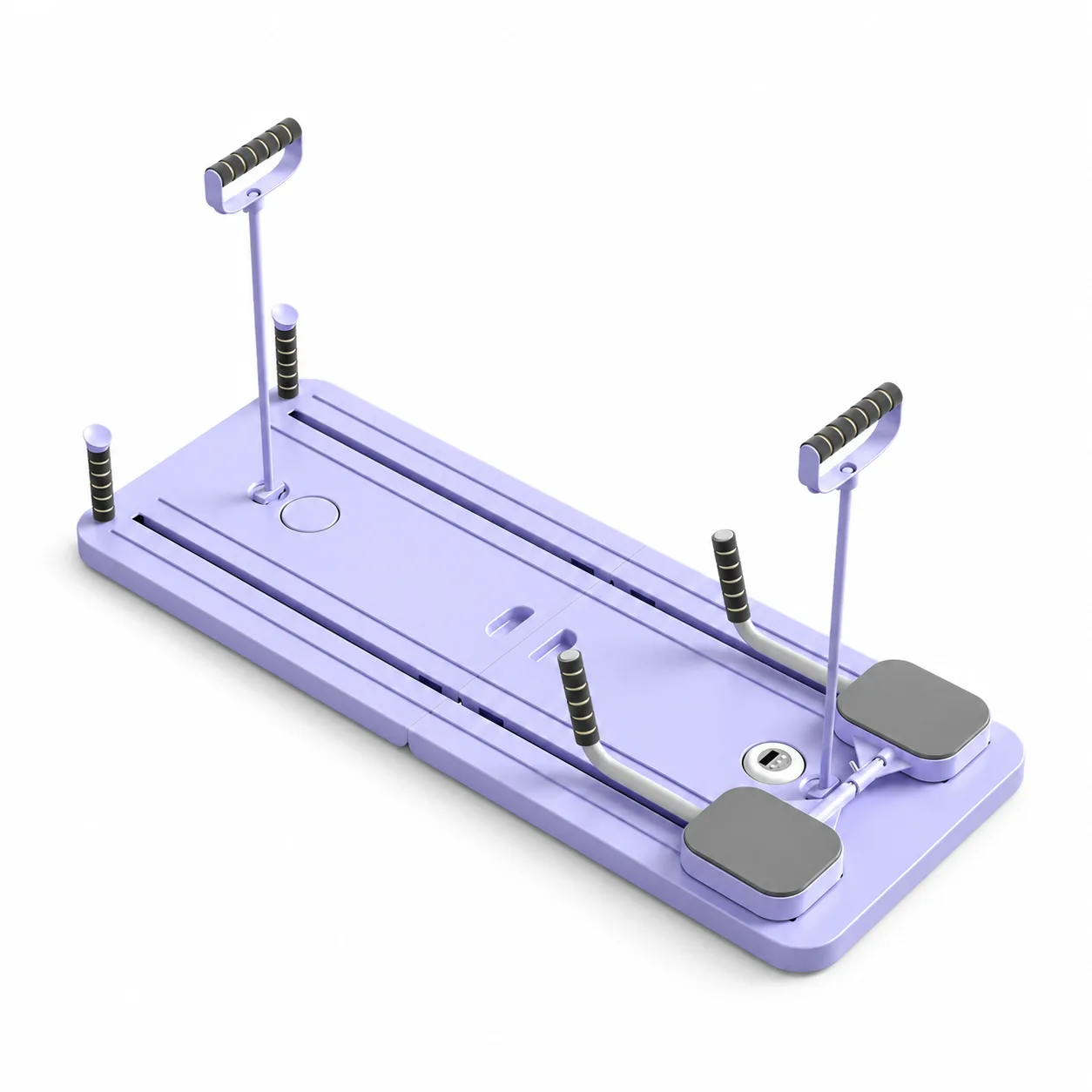
A foldable pilates reformer board splits down the middle so it can slide under a bed or stand inside a closet. When unfolded on hardwood, tile, or low-pile carpet, the center hinge must sit completely flush with the floor so the sliding carriage does not catch or click as it crosses the midpoint seam. Multi-point underside non-slip pads prevent the frame from shifting horizontally during high-tension push-outs.
3. Elastic Resistance Cord Anchors and Push-Up Grip Angles
Most multi-function Pilates boards pair their sliding core track with front or side anchor points for elastic resistance cords, plus detachable push-up handles and cushioned knee pads. Because elastic cords increase tension progressively as they stretch—unlike the more uniform linear curve of long studio metal springs—secure carabiner or slot anchors are essential for maintaining symmetrical shoulder load during seated biceps curls, chest presses, and high rows.
4. Deck Width, Knee Pad Density, and Accessory Compatibility
Checking individual model dimensions and included attachments across the Pilates Boards collection helps you confirm that the kneeling pad spacing matches your hip width and that the handle positions support neutral wrist alignment during plank and push-up variations.
Pilates Board vs Foldable Pilates Reformer Board: Side-by-Side Comparison Matrix
Use this specification matrix to compare single-piece portable Pilates boards, foldable multi-accessory boards, and commercial studio Reformers across footprint, resistance mechanics, and movement scope:
| Specification & Performance Criterion | One-Piece Portable Pilates Board | Foldable Pilates Reformer Board | Full Studio Reformer Apparatus | Practical Impact on Home Training |
|---|---|---|---|---|
| Track Travel & Glide Path | Continuous unseamed short linear track | Split-hinge linear track that folds in half | Full-length rail carriage for full limb extension | Governs stroke length in pikes, lunges, and rollouts |
| Resistance Mechanism | Bodyweight return assist + elastic bands | Elastic resistance cords + guided return spring | Adjustable multi-spring metal tension bar | Determines resistance curve in pulls and leg presses |
| Storage Footprint | Slides flat behind doors or against a wall | Folds into a compact half-length carry case | Requires dedicated permanent room floor space | Dictates apartment and shared-room suitability |
| Upper-Body & Grip Attachments | Multi-angle push-up sockets and band loops | Integrated push-up grips, knee pad, and bands | Shoulder blocks, adjustable footbar, and ropes | Shapes wrist alignment and upper-body exercise variety |
| Floor Surface Requirements | Needs a flat, rigid floor or firm mat base | Needs a level floor so the center hinge locks flat | Self-supported elevated frame on studio legs | Affects carriage glide smoothness across rooms |
Step-by-Step Selection Checklist for Studio and Home Practitioners
Follow this three-step pre-purchase checklist to choose the right pilates board or foldable pilates reformer board for your training goals:
- Audit Your Floor Surface and Unfolded Space: Verify that you have a flat, rigid floor area—such as hardwood, tile, or a firm high-density mat—where the board can sit without rocking. Avoid placing a foldable board directly over thick, plush shag rugs that allow the center hinge to flex downward under kneeling load.
- Match Resistance Attachments to Your Core and Upper-Body Routine: If your primary goal is combining guided ab rollouts with upper-body resistance toning, choose a board package that includes detachable push-up handles, a cushioned knee pad, and dual elastic resistance bands. For wider multi-planar leg sweeps outside the linear track, pair your board sessions with Pilates sliders on smooth flooring.
- Review Model-Specific Dimensions and Setup Instructions: Before ordering, compare the unfolded length, deck width, and included accessory list on each product page, and understand that portable boards are designed for space-saving core and resistance conditioning rather than replicating full-length studio Reformer spring travel.
Frequently Asked Questions
Does a foldable Pilates board work for home core and resistance workouts, and what are its limits compared to a studio Reformer?
Portable and foldable Pilates boards combine sliding ab-roller tracks, push-up grips, and resistance bands for compact home workouts without giving up living space to a full Reformer, though their track travel and elastic resistance are more compact than a studio Reformer. They are highly effective for anterior core control, kneeling planks, lunges, and banded arm work, while full-length supine leg-spring series remain the domain of studio apparatus.
What specifications matter most when comparing pilates board?
The most important specifications are roller track smoothness, unfolded frame rigidity, non-slip floor grip pads, cushioned knee pad density, and the security of the elastic band and push-up handle attachment slots. Checking product-specific dimensions ensures comfortable hip and shoulder spacing.
How does pilates board compare to foldable pilates reformer board for regular Pilates sessions?
A one-piece Pilates board offers a continuous, unseamed track for slightly faster setup in a dedicated workout corner, whereas a foldable Pilates reformer board hinges in half for closet or under-bed storage while delivering the same guided core rollout and banded resistance exercises on a level floor.
Make it part of your practice
Explore the charcoal folding pilates board and check its product details before choosing your studio essentials.
View this piece