


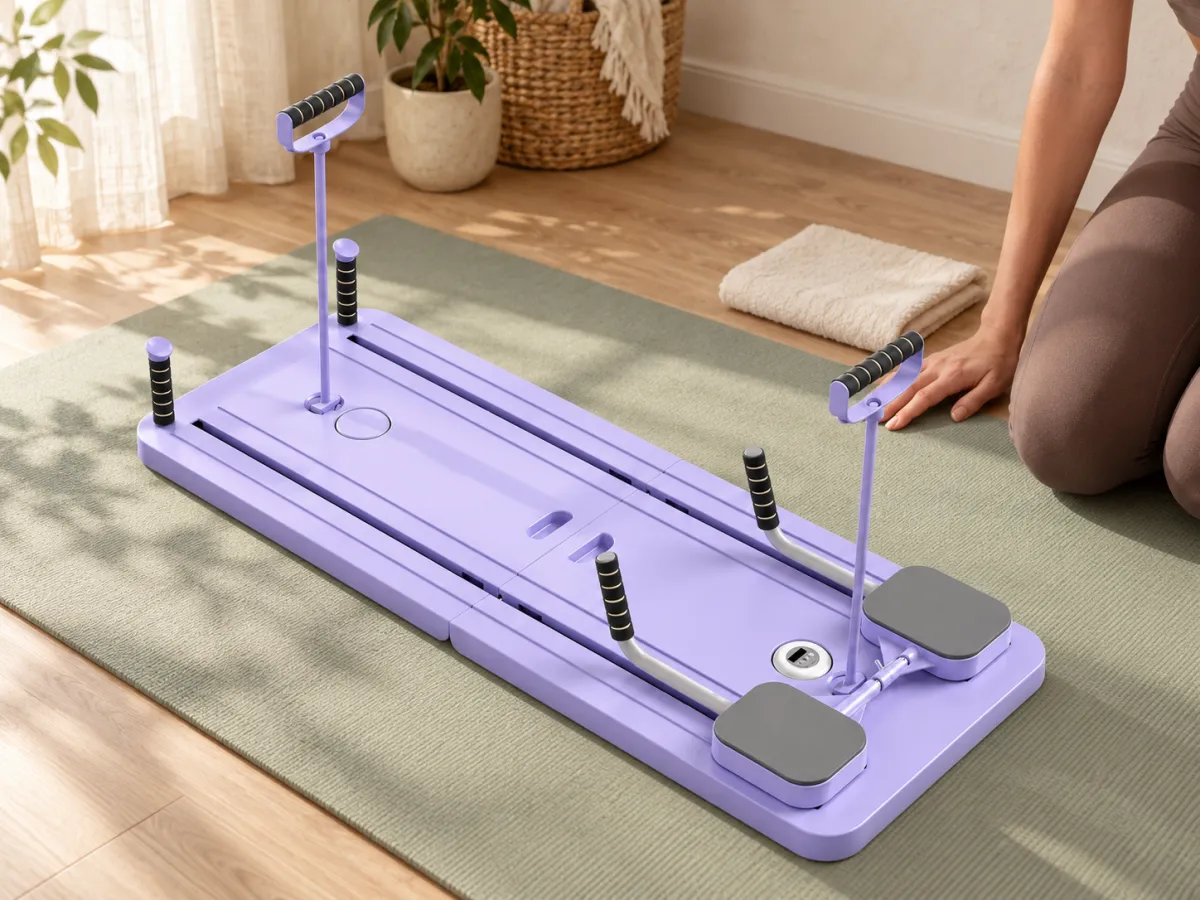
Comparing a Pilates board vs Reformer—and understanding how a mini Reformer board vs studio Reformer differs in track dimensions, body-proportion clearance, and class etiquette—helps you choose the right apparatus for your living room and transition smoothly into studio sessions. While portable and foldable Pilates boards combine sliding ab-roller tracks, push-up grips, and resistance bands so you can train at home without dedicating a room to a full machine, their track travel and elastic resistance are more compact than a studio Reformer.
According to the PilatesFits catalog listing, the Pilates Boards collection features portable and foldable Pilates boards for home workouts, with product dimensions, included accessories, and use instructions available before orders open.
Why Sizing and Proportions Matter for Pilates Board Vs Reformer in Motion
When evaluating a Pilates board vs Reformer in dynamic motion, three dimensional and mechanical factors determine how your body fits the equipment.
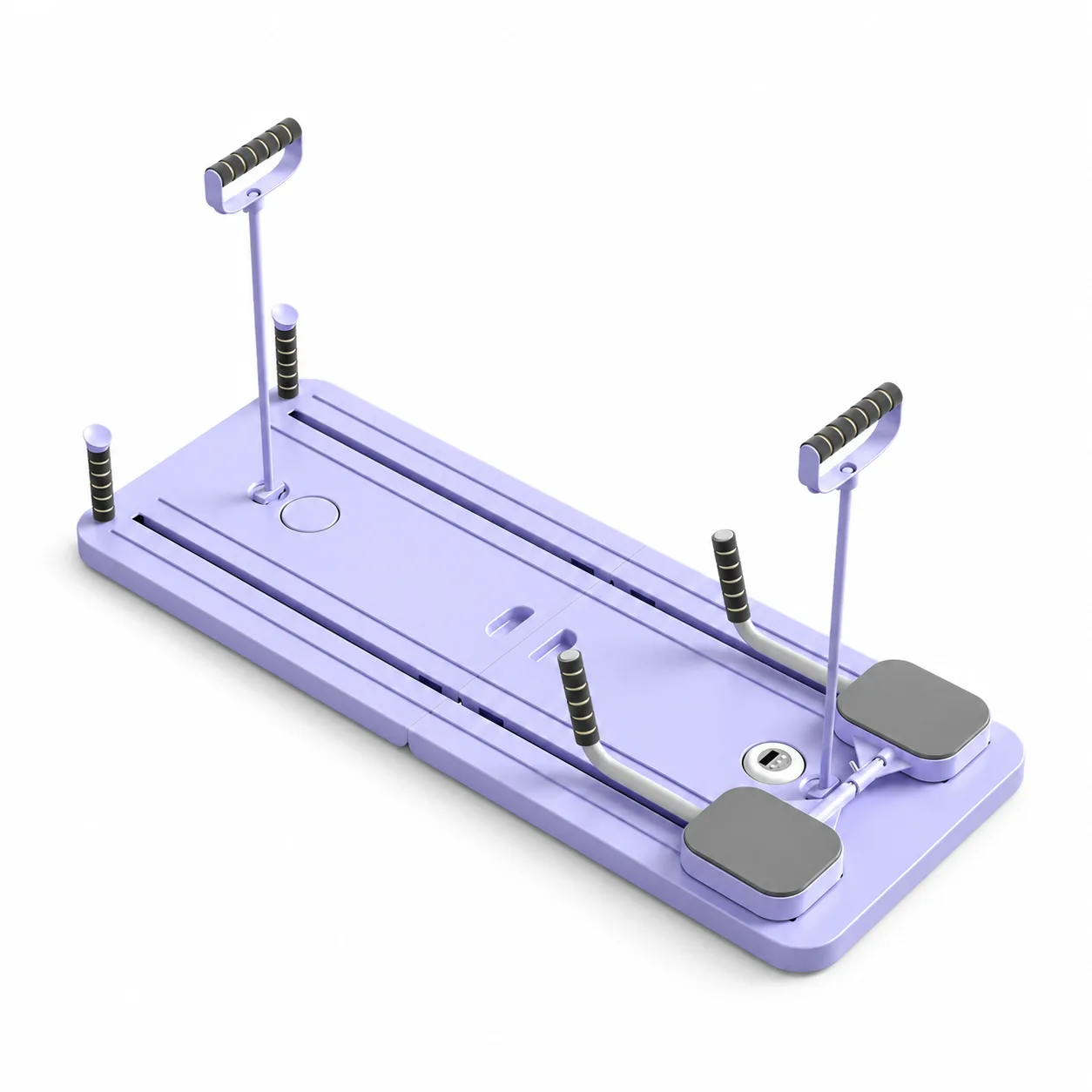
First, examine linear track stroke length versus torso and limb proportions. A commercial studio Reformer features a long wheeled carriage engineered to accommodate full-body supine lie-downs, wide second-position Footwork, and overhead Long Spine extensions across a broad range of user heights. By contrast, a mini Reformer board vs studio Reformer comparison shows that a portable foldable board focuses on a compact linear glide channel tailored for kneeling ab rollouts, plank pikes, and seated or kneeling resistance cord work. Taller practitioners can still train effectively on a compact board by adjusting their kneeling starting distance from the end stop so the carriage never bottoms out mid-rep.
Second, consider stance width and grip ergonomics. Portable Pilates boards position detachable push-up handles and resistance band anchors along a compact deck width. Matching handle slot positions to your acromion (shoulder-bone) width prevents internal shoulder rotation and wrist crease compression during plank slides and chest presses.
Third, account for floor footprint and studio policy boundaries. A foldable Pilates board is purpose-built for apartment floors and under-bed or closet storage, whereas studio group classes provide commercial Reformers and require form-fitting apparel and non-slip grip socks rather than bring-your-own floor boards.
Pilates Board Vs Reformer vs Mini Reformer Board Vs Studio Reformer: Measurement & Fit Chart by Body Type
Use the five-row sizing and proportion comparison matrix below to evaluate a Pilates board vs Reformer and see how a mini Reformer board vs studio Reformer fits your space and frame:
| Sizing & Fit Dimension | Portable / Mini Foldable Pilates Board | Full Commercial Studio Reformer | How Body Proportions Affect Setup | Practical Home & Studio Fit Rule |
|---|---|---|---|---|
| Track Stroke & Glide Travel | Compact linear ab-roller track designed for kneeling slides, plank pikes, and lunge glides | Full-length wheeled carriage track supporting supine Footwork, Hundred, and Long Box series | Taller users or long femurs reach the end of a compact board track sooner during full extensions | Position your kneeling pad or anchor foot slightly back from the board so the glide carriage retains buffer room at peak reach |
| Deck Width & Handle Spacing | Compact foldable deck with multi-angle push-up grip slots and side cord anchors | Wide upholstered carriage bed with adjustable shoulder blocks and footbar positions | Broad shoulders require wider grip slots to keep wrists stacked directly beneath the elbows | Select outer handle slots on the board if your shoulders feel pinched during plank slides or push-ups |
| Resistance Mechanism & Scaling | Elastic resistance cords with handles plus bodyweight lever manipulation and track glide | Multiple heavy-to-light coiled steel springs hooked to the carriage gearbar | Longer arms create higher elastic cord stretch at the top of kneeling overhead presses | Choke up slightly on the cord straps or perform seated rows if overhead cord tension feels excessive for your torso height |
| Floor Clearance & Surface Fit | Fits in a compact living-room floor rectangle and folds in half for closet or under-bed storage | Requires dedicated permanent floor length plus perimeter clearance for pulley straps and jumping | Folding center hinges require a rigid, level subfloor so body weight does not bow the seam | Always unfold a portable Pilates board on flat hardwood or tile rather than plush carpet |
| Studio Class Etiquette & Use Case | Designed for at-home daily core and resistance workouts; not carried into Reformer studio classes | Provided on-site at Pilates studios where classes require grip socks and form-fitting attire | Home board practice builds rib-to-hip control that transfers directly to studio carriage stability | Use your portable board for home maintenance sessions and bring only grip socks and studio essentials to machine classes |
First-Class Verification Test Before Stepping Onto the Carriage
Whether you are setting up a new home board from the PilatesFits Pilates Board collection or preparing to transition from home workouts to a studio machine, run this four-step fit and range-of-motion test:
- Review per-product dimensions and instructions before unfolding: Because product dimensions, included accessories, and use instructions are provided per product in the collection, check the exact unfolded footprint and attachment guide for your model and place it on a flat, hard floor.
- Test your kneeling shoulder-to-knee stroke clearance: Kneel on the padded glider with hands on the push-up grips and perform one slow five-second slide forward; verify that your torso reaches a strong plank line before the glider touches the front stop.
- Add floor sliders when you need wider stance angles: If your hip structure or femur length calls for wider diagonal lunges or circular leg sweeps beyond a linear track, pair your board routine with discs from the Pilates Sliders collection on the surrounding floor.
- Check cord symmetry and studio readiness: Confirm both elastic resistance cords clip securely at equal length for home upper-body rows, and remember that when you attend a commercial studio Reformer class, the studio supplies the apparatus while you wear form-fitting clothing and grip socks.
Frequently Asked Questions
Does a foldable portable Pilates board work for home workouts, and how does it differ from a studio Reformer?
Yes—a portable and foldable Pilates board works effectively for compact home workouts by combining a sliding ab-roller track, push-up grips, and resistance bands without taking up living space like a full Reformer. Its track travel and elastic cord resistance are more compact than a studio Reformer, which uses a full-length wheeled carriage and metal springs.
How do I choose the right size or dimension for pilates board vs reformer?
When choosing between a Pilates board and a Reformer for home use, measure your available flat hard-floor space and compare the per-product unfolded dimensions, track length, and included accessories in the catalog listing. Ensure you have enough clear floor length behind and in front of the board to kneel and extend your arms overhead without hitting furniture.
What should I know about mini reformer board vs studio reformer before attending a studio Pilates class?
Understand that a mini Reformer board is a compact home training tool for kneeling core slides, push-ups, and elastic band resistance, whereas a studio Reformer is a full-length spring carriage machine provided by the studio. Practicing slow, controlled ribcage-to-pelvis alignment on your home board builds core awareness that helps you stabilize the moving carriage in your first studio class.
Make it part of your practice
Explore the charcoal folding pilates board and check its product details before choosing your studio essentials.
View this piece