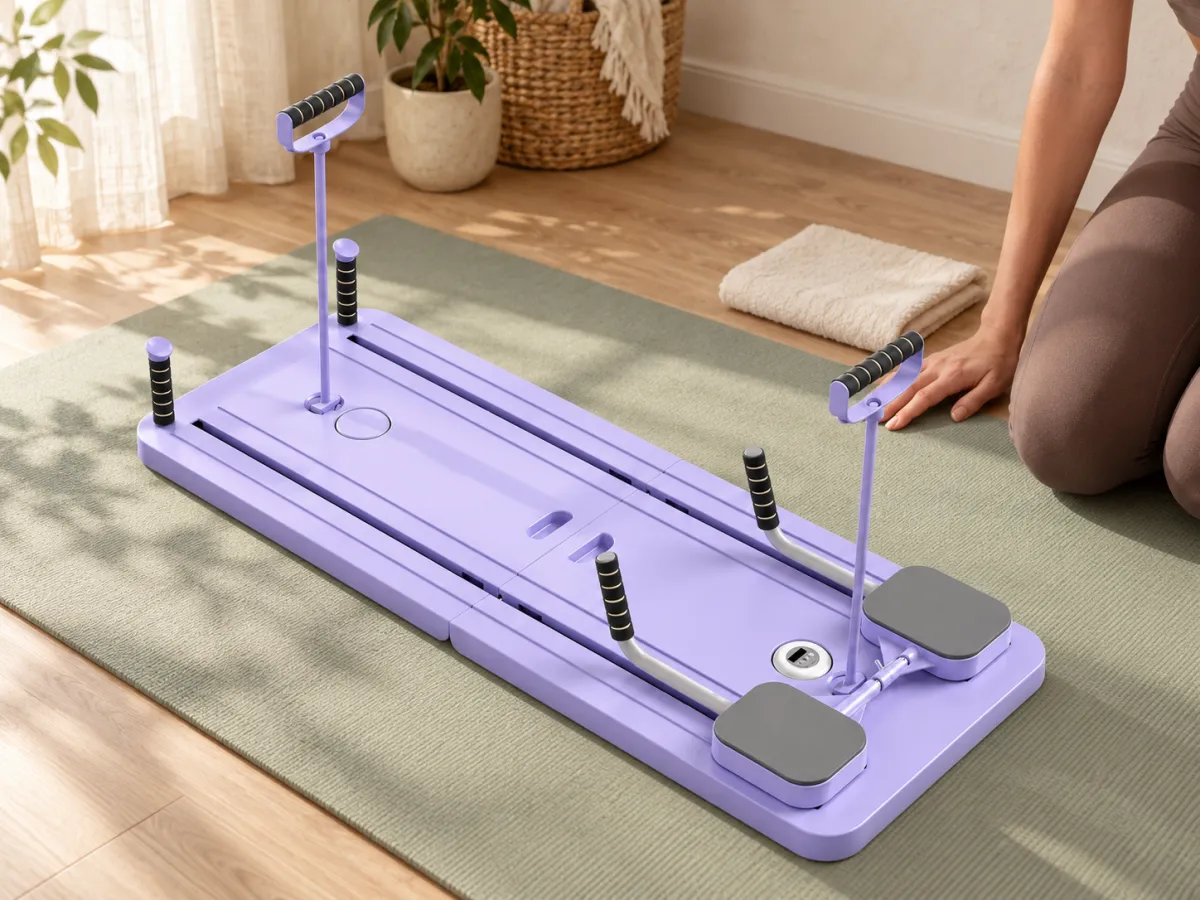
Structuring an effective pilates board workout at home starts with mastering how to use a pilates board to control eccentric return tension, maintain lumbopelvic stability, and sequence sliding carriage drills with elastic resistance cords. While a compact floor board operates on a shorter linear track and uses elastomer cords rather than the long metal springs of a studio Reformer, applying strict tempo and breath cues transforms simple floor slides into deep transverse abdominis, glute, and scapular conditioning.
According to the PilatesFits catalog listing, the Pilates Boards collection explores portable and foldable Pilates boards for home workouts, where product dimensions, included accessories, and use instructions will be available before orders open.
How Pilates Board Workout Translates Reformer Mechanics to the Floor
A purposeful pilates board workout translates three foundational studio Reformer principles onto a compact, low-profile floor track:
1. Guided Linear Instability and Deceleration Control
On a studio Reformer, the rolling carriage challenges your core to decelerate spring tension on the return phase. On a portable Pilates board, the guided ab-roller platform or dual-glider channel creates a similar linear shear challenge close to the floor. Instead of letting the return assist or elastic cord snap your knees forward, slowing the return phase to a three-second count keeps your anterior core under continuous isometric and eccentric tension.
2. Progressive Elastomer Resistance vs Studio Metal Springs
Most portable Pilates boards integrate front or side attachment loops for elastic resistance cords with handles. Because elastic bands build tension progressively near peak extension, pairing seated or tall-kneeling band rows with pelvic-floor and rib-cage closure replicates the postural demands of Reformer Back Rowing and Chest Expansion without needing an elevated frame.
3. Honest Mechanical Scope Boundaries
Use this translation matrix to see where a compact home board excels and where it differs from a full commercial Reformer apparatus:
| Studio Reformer Movement Family | Home Pilates Board Translation | Primary Muscle & Control Focus | Mechanical Scope Boundary |
|---|---|---|---|
| Knee Stretch & Elephant Series | Kneeling carriage tucks and plank pikes on the sliding track | Deep transverse abdominis, hip flexors, and serratus anterior | Shorter linear stroke focuses on peak core flexion rather than long stride length |
| Scooter & Standing Split Lunges | Single-foot glider reverse lunges with standing leg anchored on floor | Gluteus medius, hamstring eccentric control, and pelvic leveling | Floor-level foot placement requires level hard flooring for smooth glide |
| Seated Arm Work & Rowing | Tall-kneeling or seated resistance cord presses, curls, and high rows | Scapular retractors, posterior deltoids, and anti-extension core | Progressive elastic band curve differs from constant-rate metal studio springs |
| Long Box Pulling Straps | Prone push-up handle planks and controlled short-range rollouts | Latissimus dorsi, triceps, and lumbopelvic anti-sagging control | Compact deck width keeps movements centered along the midline rail |
Step-by-Step How To Use A Pilates Board Sequence: Core, Glutes & Spinal Articulation
Follow this four-exercise sequence to learn how to use a pilates board with clean studio-inspired alignment and breath pacing:
1. Kneeling Carriage Ab Tuck (Reformer Knee Stretch Translation)
Place the cushioned knee pad beneath both knees and grip the angled push-up handles with wrists neutral and shoulders stacked over your hands. Exhale to draw your lower ribs toward your pelvis, pulling the sliding platform forward under your hips without rounding your upper back, then inhale for a slow three-count return.
2. Controlled Plank Rollout (Long Stretch Translation)
From a kneeling plank on the Pilates Boards collection track, maintain a gentle posterior pelvic tilt as you glide the handles or carriage forward only as far as your lumbar spine remains completely neutral. Exhale and press through your palms and lats to draw the carriage back to the starting stop.
3. Single-Leg Split Lunge Glide (Scooter Translation)
Stand with your working foot on the stable floor beside or ahead of the board and place your trailing forefoot on the sliding glider channel. Inhale as the glider travels back into a controlled single-leg lunge while keeping both hip bones squared forward; exhale and drive through your front heel to return the carriage smoothly.
4. Tall-Kneeling Banded Chest Expansion and Row
Kneel upright on the padded deck, grasp the elastic resistance cord handles at hip height, and draw the cords straight back past your hips while lengthening the crown of your head toward the ceiling. Hold for two counts with collarbones wide before releasing tension with control.
Setup Boundaries and Progression Rules Without a Studio Machine
To prevent form breakdown and joint strain during your pilates board workout, apply these three setup and progression rules:
- Always Set Up on a Rigid, Level Floor Surface: Unfold your board on hardwood, tile, or a firm, thin mat so the center hinge and underside grip pads sit completely flat. Plush carpet allows foldable hinges to flex under kneeling weight and causes roller bearings to bind.
- Progress Tempo Before Adding Range of Motion: Because compact boards have a finite linear track length, increase difficulty by slowing the eccentric return to four seconds or adding a two-second isometric pause at peak extension rather than forcing the rollers against the end stops.
- Expand Multi-Planar Work with Complementary Floor Props: Since a Pilates board guides movement along a single straight rail, combine your routine with Pilates sliders when you want wide circular leg sweeps, diagonal lunges, or lateral adductor glides.
Frequently Asked Questions
Does a foldable Pilates board work for home core and resistance workouts, and what are its limits compared to a studio Reformer?
Portable and foldable Pilates boards combine sliding ab-roller tracks, push-up grips, and resistance bands for compact home workouts without giving up living space to a full Reformer, though their track travel and elastic resistance are more compact than a studio Reformer. They deliver effective core, lunge, and upper-body resistance training while occupying minimal closet space.
Can pilates board workout replace a studio Reformer workout at home?
A Pilates board workout cannot replicate full-length supine Footwork or heavy metal spring travel on a commercial Reformer, but it effectively substitutes kneeling core tucks, plank pikes, single-leg lunges, and banded upper-body rows in apartments and home studios.
How do you structure a balanced how to use a pilates board routine for core and lower body?
Start with kneeling abdominal tucks and short-range rollouts to activate deep core stabilizers, transition to standing single-leg lunge glides for glute and hamstring control, and finish with tall-kneeling resistance band rows to balance anterior pushing work with scapular retraction.
Make it part of your practice
Explore the lavender pilates training board with handles and check its product details before choosing your studio essentials.
View this piece