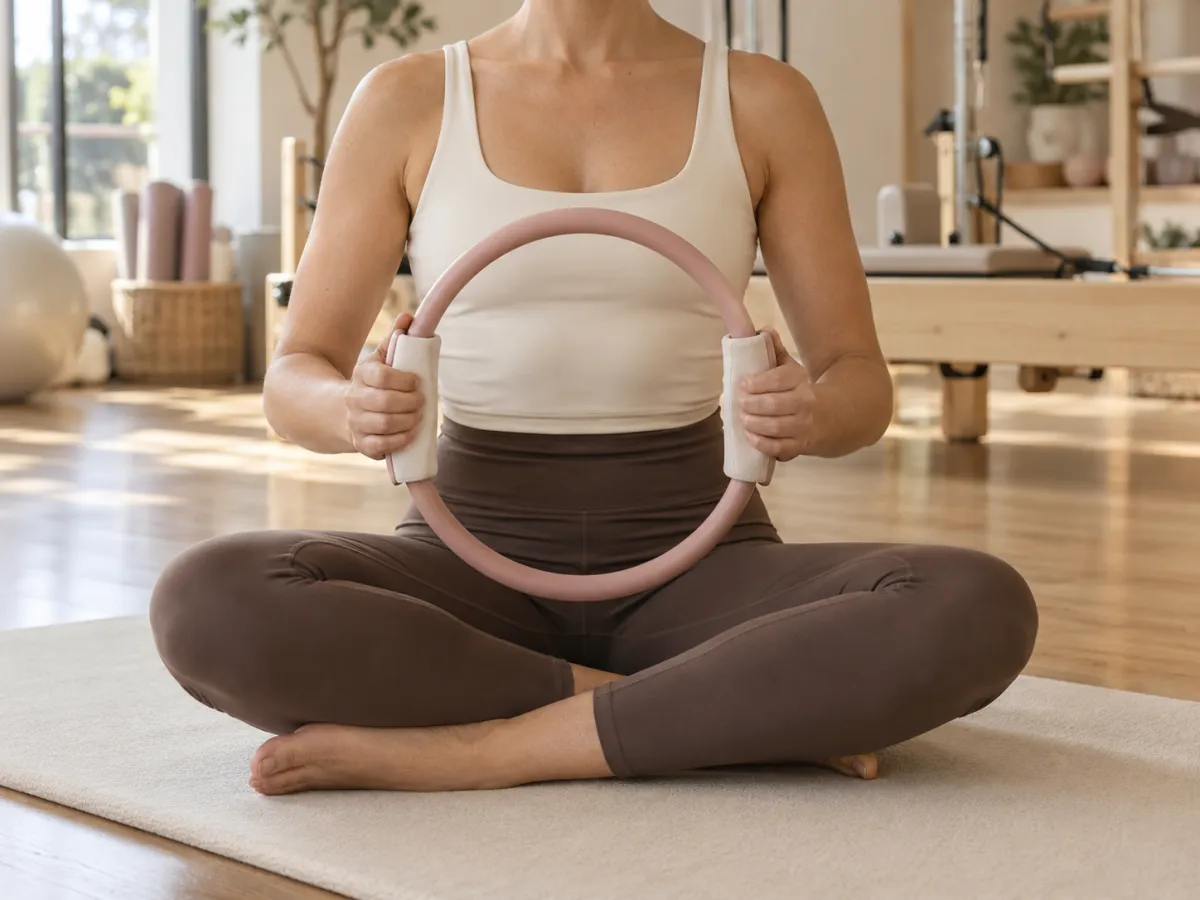
Practicing pilates ring exercises on a mat gives you the closed-chain feedback, midline reference, and reciprocal core recruitment of studio apparatus work without needing a full frame in your living room. A well-structured magic circle pilates workout uses the ring’s dual-pad compression and outer-edge abduction to mimic the footbar, shoulder blocks, and strap tension of a Reformer carriage—provided you understand both what the ring translates accurately and where spring-loaded travel cannot be duplicated on the floor.
According to the PilatesFits catalog listing, the Pilates Rings collection covers Pilates rings (magic circles) compared by diameter and handle style for targeted exercises.
How Pilates Ring Exercises Translates Reformer Mechanics to the Floor
On a studio Reformer, your nervous system receives constant tactile feedback from the moving carriage, the shoulder blocks, and the straps. When you move to the floor without props, that closed-chain boundary disappears, and limbs often drift out of alignment. Integrating Pilates rings and magic circles restores a physical boundary between your hands or legs so your deep stabilizers fire before global prime movers take over.
| Studio Reformer Element | Magic Circle Mat Equivalent | Primary Biomechanical Function | Honest Mechanical Boundary |
|---|---|---|---|
| Footbar & Carriage Return | Supine bridged adductor press with dual pads between inner thighs | Co-contracts pelvic floor, adductors, and transverse abdominis during hip extension | Fixed-spring isometric squeeze rather than long-excursion horizontal carriage travel |
| Double Loops / Arm Straps | Supine Hundred and seated spine twist holding outer handle pads | Connects latissimus dorsi and serratus anterior into the anterior core wall | Constant inward compression rather than overhead pulley cable resistance |
| Outer-Thigh Strap Abduction | Side-lying or bridged ankle placement pressing outward into interior pads | Recruits gluteus medius and deep external rotators to stabilize the pelvis | Short-range isometric push rather than multi-spring cable excursion |
| Long Box Teaser & Swan | Prone chest lift and supine roll-up pressing palms into the top pad | Creates axial elongation and scapular depression away from the ears | Floor gravity acts vertically rather than along an angled rope path |
When selecting a ring for mat-to-Reformer translation, compare ring diameter and handle style against your shoulder width and stance alignment. Dual-pad handles—with contoured foam or molded inner and outer crescents—let you switch seamlessly from inward adduction (squeezing the pads together) to outward abduction (stepping inside the circle and pressing outward against the inner pads). If you also want cushioned support under your sacrum or upper thoracic spine during flexion progressions, pairing your ring with an inflatable mini stability ball from the Pilates Balls collection adds unstable surface feedback underneath the pelvis while the ring organizes your upper or lower extremities.
Step-by-Step Magic Circle Pilates Workout Sequence: Core, Glutes & Spinal Articulation
To replicate the rhythm of a studio class, organize your magic circle pilates workout in the same progression an instructor uses on the Reformer: supine footwork and pelvic bridging first, upper-abdominal endurance second, seated rotational control third, prone posterior-chain extension fourth, and side-lying hip stabilization last. Follow these five foundational pilates ring exercises with deliberate breath pacing and controlled spring recoil.
Supine Bridge With Inner-Thigh Adductor Pulse
- Setup: Lie supine with knees bent, feet hip-distance apart on the mat, and the external pads of the magic circle resting between your inner thighs just proximal to the knee joint line.
- Execution: Exhale to imprint and articulate your spine off the mat one vertebra at a time into a neutral shoulder-to-knee bridge. Maintaining rib-to-hip connection, gently press the pads inward on a slow exhale until you feel deep lower-abdominal and adductor engagement, then resist the spring’s outward recoil on the inhale without letting the circle snap open.
- Form Cue: Keep your tailbone reaching toward the backs of your knees so glutes and hamstrings share the load with the inner thighs rather than cramping the hip flexors.
The Hundred With Isometric Pectoral & Serratus Press
- Setup: From supine tabletop (knees stacked over hips, shins parallel to the floor) or extended legs, hold the outer handle pads between the heels of your palms with arms reaching toward the ceiling and elbows softly micro-bent.
- Execution: Exhale to nod the chin and curl your head, neck, and shoulder blades off the mat while lowering the ring toward hip height. Instead of pumping the arms loosely from the shoulders, maintain a steady, gentle inward press on the handle pads while breathing in for a slow count and exhaling fully as your lower back stays anchored.
- Form Cue: Press from the underside of your armpits (serratus anterior and latissimus dorsi) rather than clenching your fingers or rolling your upper traps toward your ears.
Seated Roll-Down & Spine Twist With Midline Frame
- Setup: Sit tall on your sit bones with knees slightly bent and heels anchored into the mat, holding the outer pads of the ring at sternum height with elbows wide.
- Execution: For the roll-down, exhale and scoop the abdominals backward while pressing lightly into the pads to keep the collarbones broad, pausing halfway down where your lumbar spine lengthens before articulating back up. For the spine twist, sit tall on an inhale and rotate your ribcage and breastbone as a single unit on the exhale—keeping the ring centered directly in front of your sternum so your arms never swing past your torso.
- Form Cue: If your hip flexors grip during seated work, sit on a folded mat edge so your pelvis remains vertical before initiating compression.
Prone Swan Prep With Overhead Pad Press
- Setup: Lie prone with legs extended hip-width apart, pubic bone anchored into the mat, and the magic circle standing vertically on the floor ahead of your crown with both palms resting stacked on the top handle pad.
- Execution: Inhale to slide your shoulder blades down your back and press gently downward into the top pad, lifting your breastbone and upper thoracic spine into a long arc without jamming your lower lumbar vertebrae. Exhale to lengthen the crown of your head forward as you lower back to the mat under control.
- Form Cue: Use the ring’s vertical recoil as an elevator guide for scapular depression—never collapse your weight onto locked elbows.
Side-Lying Ankle Abduction & Adduction Series
- Setup: Lie on your side aligned with the back edge of your mat, bottom arm supporting your head, and place both ankles either outside the external pads (for adduction) or inside the internal crescent pads (for abduction).
- Execution: Float both legs slightly off the mat by engaging your lateral obliques. For adduction, press the top leg down into the top pad and hold briefly before resisting the upward return; for abduction, press both ankles outward against the interior pads to fire the lateral glutes and tensor fasciae latae.
- Form Cue: Keep your top hip stacked directly over your bottom hip so the pelvis does not roll backward when the ring resists your leg.
Setup Boundaries and Progression Rules Without a Studio Machine
Working through a pilates ring guide at home requires respecting the mechanical differences between a flexible tension ring and a spring-driven Reformer carriage. First, a magic circle delivers fixed-spring isometric resistance: you cannot swap out heavy and light springs on a single ring the way you unhook red, blue, or yellow springs on a Reformer. Instead, you modulate intensity by changing lever length (placing the ring at the ankles creates a longer lever than placing it above the knees) and time under tension (holding the peak squeeze and slowing the eccentric release).
Second, check pad placement before every set. Dual-pad handles are designed to rest against flat muscular contours—the distal inner thigh above the knee joint, the outer ankle malleolus area with slight shin alignment, or the heel of the palm—never directly across a vulnerable joint line or with bent wrists. When searching for the best pilates ring for reformer crossover training at home, prioritize how ring diameter fits your frame and whether the dual-pad handle geometry stays stable during both inward squeezes and outward presses.
Finally, apply these essential pilates ring tips to progress your sessions safely: master eccentric recoil control before adding repetitions. If the ring wobbles, twists in your hands, or snaps outward at the end of a press, reduce your compression force by half and focus on keeping your ribcage knitted over your pelvis throughout the entire breath cycle.
Frequently Asked Questions
How does a Pilates magic circle ring compare to basic thigh squeezers for inner-thigh and full-body Pilates exercises?
Pilates rings (magic circles) are compared by ring diameter and dual handle style, offering broader exercise versatility for mat routines than single-pattern plastic thigh squeezers. Because a magic circle features dual inner and outer crescent pads around a symmetrical circle, you can use it for both inward adduction and outward abduction across upper-body, core, and lower-body Reformer-style flows, whereas a hinged plastic thigh toner only allows a single inward V-squeeze pattern.
Can pilates ring exercises replace a studio Reformer workout at home?
Practicing pilates ring exercises on a mat replicates the midline alignment, closed-chain tactile feedback, and isometric core co-contraction of studio Reformer sequences, making it one of the most effective compact home alternatives. However, a magic circle provides short-range isometric compression and abduction rather than the long-range eccentric carriage travel and adjustable multi-spring loading of a studio Reformer machine.
How do you structure a balanced magic circle pilates workout routine for core and lower body?
Structure your magic circle pilates workout across all planes of spinal movement: begin with supine pelvic bridging and inner-thigh adduction to wake up the deep core and adductors, transition into supine abdominal flexion and seated spinal rotation holding the outer pads to keep the shoulder girdle organized, and finish with prone thoracic extension and side-lying ankle abduction to balance the posterior chain and lateral hip stabilizers.
Make it part of your practice
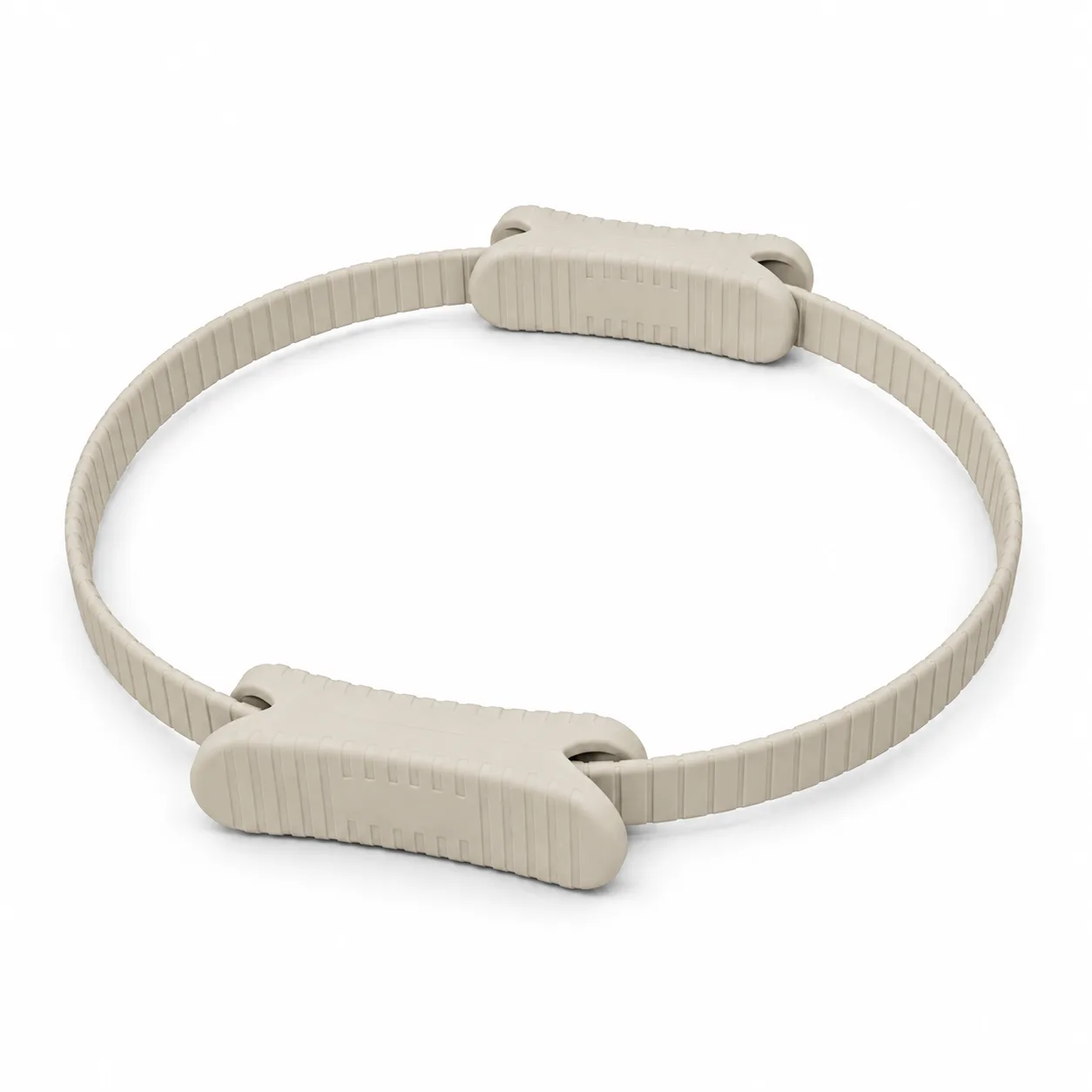
Explore the blush pilates ring with white pads and check its product details before choosing your studio essentials.
View this piece