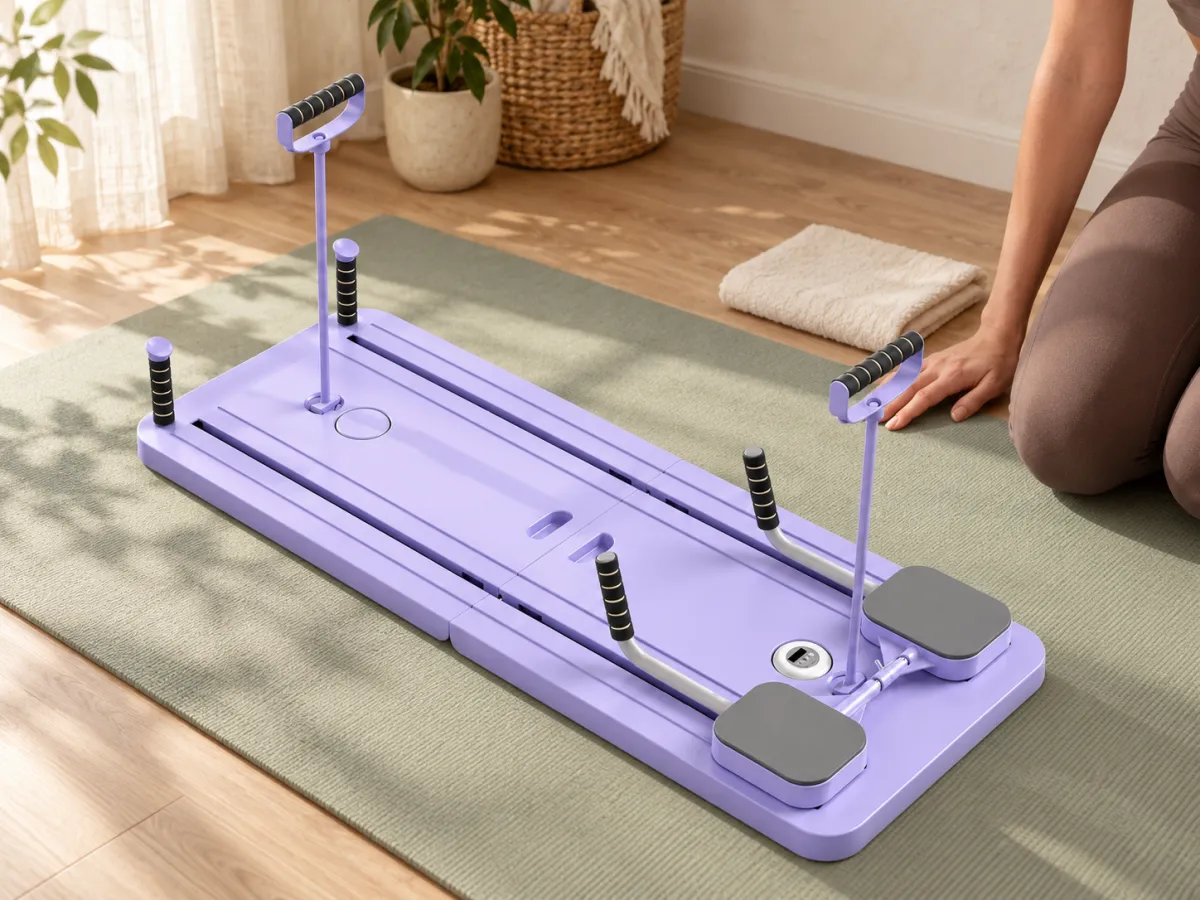
Shopping for a portable pilates reformer for small spaces often brings practitioners to a critical engineering crossroads: choosing between a foldable sliding Pilates board, a cord-resisted micro-carriage, or a full-length folding Reformer frame. When evaluating any compact home pilates machine, the label alone does not tell you whether the apparatus can support supine leg work, how much linear track stroke is available for kneeling pikes, or whether the chassis stores flat under a standard apartment sofa. Understanding the mechanical distinctions between linear ab-track Pilates boards and full-carriage machines ensures you invest in equipment that fits both your floor dimensions and your training goals.
According to the PilatesFits catalog listing, the Pilates Boards collection features portable and foldable Pilates boards for home workouts, with product dimensions, included accessories, and use instructions available before orders open.
Key Specifications to Compare When Shopping for a Portable Pilates Reformer for Small Spaces
When apartment dwellers search for a portable pilates reformer for small spaces, they are typically balancing active floor footprint against storable volume. However, shrinking an apparatus changes three fundamental biomechanical variables:
- Linear track stroke length vs. user femur and torso geometry: A commercial studio Reformer features a long rail frame that allows a supine practitioner to press out from deep hip and knee flexion to full extension without hitting an end bumper. By contrast, a portable foldable Pilates board uses a condensed linear slider channel designed specifically for kneeling rollouts, core pikes, planks, and seated band work rather than full-body supine footbar presses.
- Resistance curve (elastic cords vs. metal coil springs): Studio Reformers use color-coded steel springs that provide predictable linear hookean tension across a long travel arc. Compact Pilates boards integrate elastic resistance tubes anchored to the front or sides of the deck, offering progressive tension for upper-body rows, chest presses, and torso rotations while relying on bodyweight leverage along the sliding track.
- Chassis rigidity and hinge locking under load: A foldable polymer Pilates board relies on floor contact and anti-slip base pads to stabilize its center hinge, whereas a wheeled folding metal Reformer stands on elevated legs or low-profile rails.
Portable Pilates Reformer for Small Spaces vs. Compact Home Pilates Machine: Side-by-Side Comparison Matrix
Use this five-row specification matrix to compare how a foldable Pilates board stacks up against other compact home pilates machine formats across footprint, resistance, and exercise compatibility:
| Apparatus Format | Active & Stored Footprint | Resistance & Glide Mechanism | Primary Exercise Compatibility | Key Mechanical Boundary |
|---|---|---|---|---|
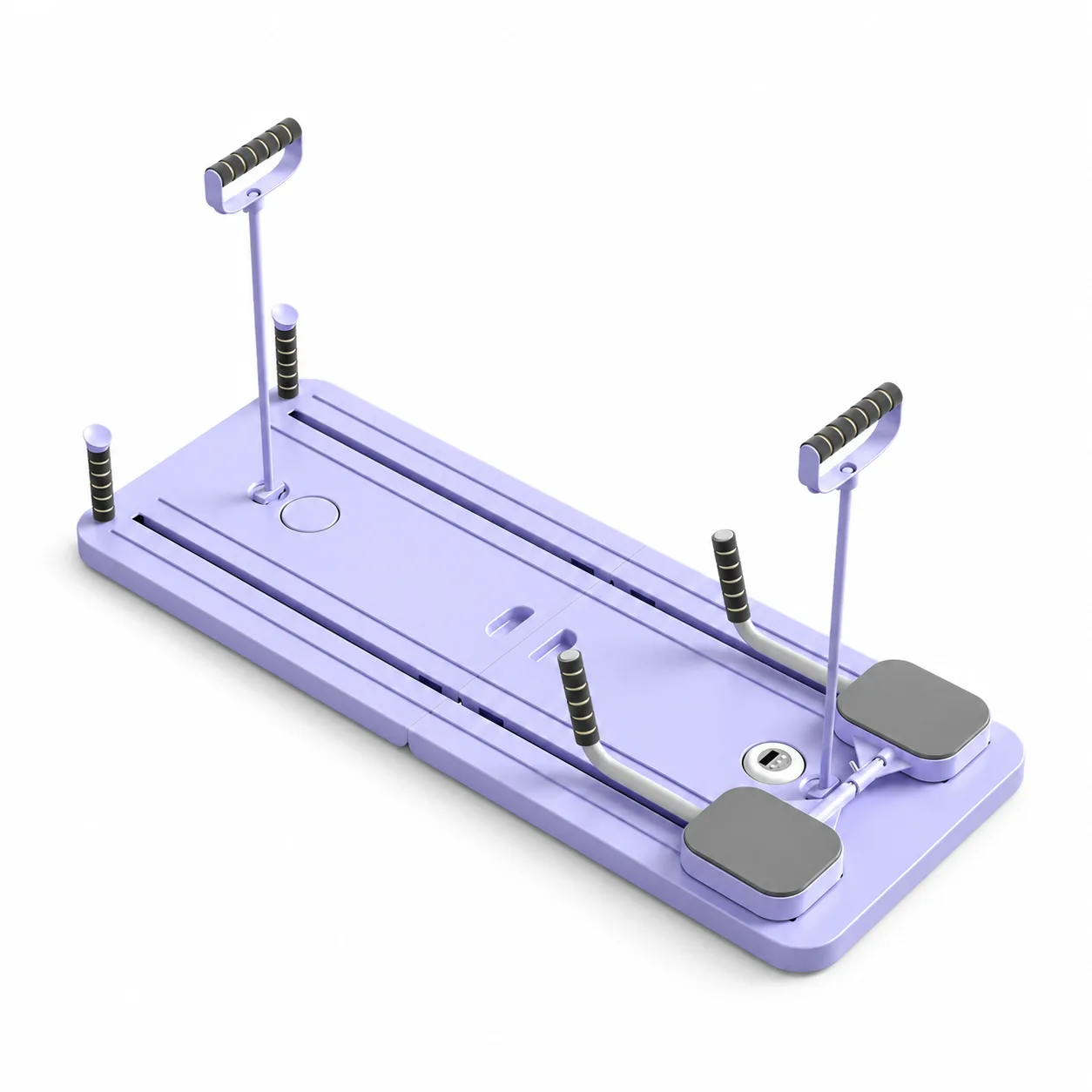
| Foldable Pilates Board (Sliding Track + Bands) | Unfolds on a standard mat footprint; folds in half to slide under a bed or stand in a narrow closet | Internal polymer roller carriage on a recessed linear track plus clip-on elastic resistance bands and push-up grips | Kneeling core pikes, ab rollouts, oblique tucks, plank saws, push-ups, and seated/standing band conditioning | Shorter linear track and elastic cord resistance do not replicate full-length supine Reformer footbar strokes or studio metal springs |
| Floor Slider Discs + Resistance Band Kit | Zero rigid frame footprint; fits in a drawer or tote bag | Friction-reducing polymer/fabric discs sliding directly on hardwood or carpet paired with latex/fabric bands | Long-lever lunges, bridging hamstring curls, mountain climbers, and mat-based core extensions | No guided rail alignment; requires the user to control 360-degree planar drift across the floor |
| Cord-Resisted Micro-Carriage (Non-Folding Rail) | Shorter and narrower than a studio Reformer, but requires dedicated wall leaning or under-bed clearance | Rolling platform on twin aluminum rails tensioned by bungee cords or light springs | High-time-under-tension planks, lunges, and kneeling carriage slides | Often lacks a full footbar, headrest, or shoulder blocks for classical supine Reformer sequences |
| Foldable Metal Home Reformer (Cord or Spring) | Full-length footprint when open; folds vertically or hinges at the center rail with transport wheels | Wheeled carriage with elastic bungee cords or light-duty steel springs and an adjustable footbar | Supine footwork, frog/circles, hundred, and light-to-moderate carriage flows | Heavier chassis requires two-handed rolling and dedicated vertical closet or corner floor space |
| Commercial Studio Reformer (Benchmark) | Permanent dedicated room footprint with 360-degree clearance for long-lever extensions | Heavy wood or anodized aluminum frame, 5-spring graduated metal resistance, and long-travel ball-bearing carriage | Full classical and contemporary Reformer repertoire including jumpboard and long-box work | High cost, heavy weight, and permanent spatial footprint make it impractical for small apartments |
Step-by-Step Selection Checklist for Studio and Home Practitioners
Before ordering a portable pilates reformer for small spaces or a foldable Pilates board, walk through this four-point spatial and biomechanical checklist:
1. Measure Both Your Active Movement Envelope and Your Storage Slot
Do not measure only the unfolded deck length. When performing kneeling rollouts or diagonal band pulls on a Pilates board, your shoulders, elbows, and extended legs project beyond the polymer chassis. Ensure you have at least six feet of clear floor length and four feet of width during training, and measure the vertical clearance under your bed frame or inside your closet to confirm the folded clamshell thickness fits cleanly.
2. Match the Track Mechanism to Your Primary Movement Goals
If your primary goal is high-tension anterior core conditioning, plank variations, push-up alignment, and compact resistance band toning without giving up living room space, a foldable Pilates board delivers an efficient all-in-one station. You can review current board layouts in the PilatesFits Pilates Boards collection and supplement your lower-body lunge sweeps with low-friction Pilates sliders. Conversely, if your practice centers on supine footbar presses and legs-in-straps hip circles, account for the fact that a compact board’s shorter linear track is not built for full-body supine carriage travel.
3. Inspect Attachment Ergonomics and Multi-Position Handle Slots
Look for a board deck with clearly indexed push-up handle sockets (allowing wide chest, neutral shoulder, and narrow triceps alignments), a high-density EVA kneeling pad that cushions the patellar tendon, and swivel carabiners on the elastic resistance cords so the tubes never twist during rotational pulls.
4. Verify Floor Compatibility Before Your First Session
A lightweight compact home pilates machine or foldable board depends on clean elastomer base feet to resist horizontal shear on hardwood and a firm, level surface to prevent center-hinge flex on plush carpet. If you train over soft bedroom carpet, plan to lay a dense exercise mat underneath the board so both halves of the linear track stay coplanar.
Frequently Asked Questions
Does a foldable Pilates board work for home core and resistance workouts, and what are its limits compared to a studio Reformer?
Portable and foldable Pilates boards combine sliding ab-roller tracks, push-up grips, and resistance bands for compact home workouts without giving up living space to a full Reformer, though their track travel and elastic resistance are more compact than a studio Reformer. Because the sliding track is shorter and uses elastic cords rather than full-length metal springs, it is best suited for kneeling core pikes, planks, and upper-body band resistance rather than full-length supine Reformer footwork.
What specifications matter most when comparing a portable Pilates reformer for small spaces?
Prioritize unfolded and folded dimensions, linear slider track smoothness, anti-slip base pad coverage, push-up grip indexing, and the anchor quality of the included elastic resistance bands. Checking how the center hinge locks flat under bodyweight load is equally important if you plan to use the board across both hardwood and carpeted rooms.
How does a portable Pilates reformer for small spaces compare to a compact home Pilates machine for regular Pilates sessions?
In everyday search terminology, both phrases often refer to foldable Pilates boards and condensed sliding-track trainers designed for apartments. A foldable Pilates board offers the fastest setup and smallest folded storage footprint for daily core, plank, and band sessions, while larger folding metal Reformers trade storage convenience and portability for a longer supine carriage stroke.
Make it part of your practice
Explore the charcoal folding pilates board and check its product details before choosing your studio essentials.
View this piece