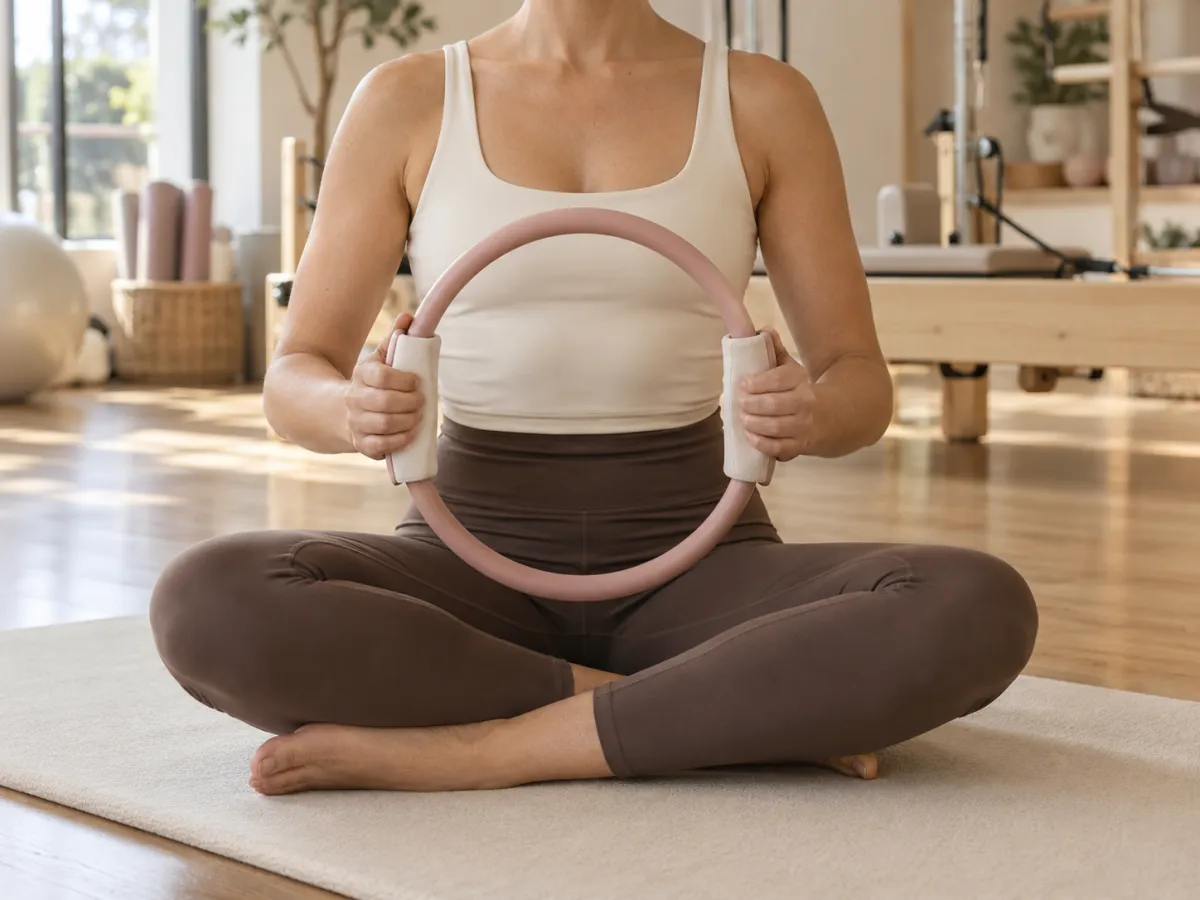
Understanding what does a pilates ring do starts with closed-chain isometric tension: pressing inward or outward against a flexible magic circle creates reciprocal core co-contraction, joint-centration feedback, and a clear midline reference during both floor and apparatus exercises. However, unlocking real pilates ring benefits—from deeper pelvic floor and adductor recruitment to balanced scapular stability—depends on eliminating common compensation habits like wrist flexing, upper-trap shrugging, and momentum-driven spring release.
According to the PilatesFits catalog listing, the Pilates Rings collection covers Pilates rings (magic circles) compared by diameter and handle style for targeted exercises.
The Biomechanics Behind What Does A Pilates Ring Do in Mat and Reformer Movements
When practitioners ask what does a pilates ring do, the simplest biomechanical answer is that it turns open-chain limb movements into closed-chain isometric challenges. In open-chain mat work, your arms and legs move freely through space, making it easy for dominant global muscles—such as the hip flexors, upper trapezius, or superficial chest fibers—to overpower deep local stabilizers. Placing a dual-pad circle from the Pilates Rings collection between your palms, thighs, or ankles introduces an external force vector that requires opposing muscle groups to co-contract around a neutral spine.
| Biomechanical Mechanism | Primary Target Tissue & Joint Organization | Mat & Reformer Movement Application | Common Compensation If Misaligned |
|---|---|---|---|
| Inward Adduction Squeeze (Hand-to-Hand) | Serratus anterior, pectoralis minor/major, and anterior oblique sling | Supine Hundred, seated spine twist, and Reformer footwork arm frames | Rolling shoulders forward and flexing the wrists instead of widening the collarbones |
| Inward Adduction Squeeze (Thigh-to-Thigh) | Adductor magnus/longus, pelvic floor, and transverse abdominis | Pelvic bridge, supine tabletop curls, and Reformer carriage return | Gripping the tensor fasciae latae and tilting the pelvis anteriorly |
| Outward Abduction Press (Inside Ring) | Gluteus medius, gluteus minimus, and deep lateral hip rotators | Side-lying leg lifts, supine bridge abduction, and seated outer-thigh pulses | Rotating the femur externally from the feet rather than abducting from the hip socket |
| Vertical Axial Press (Floor-to-Palm) | Lower trapezius, latissimus dorsi, and thoracic extensors | Prone swan prep and kneeling lat-depression drills | Hyperextending the cervical neck or locking the elbow joints |
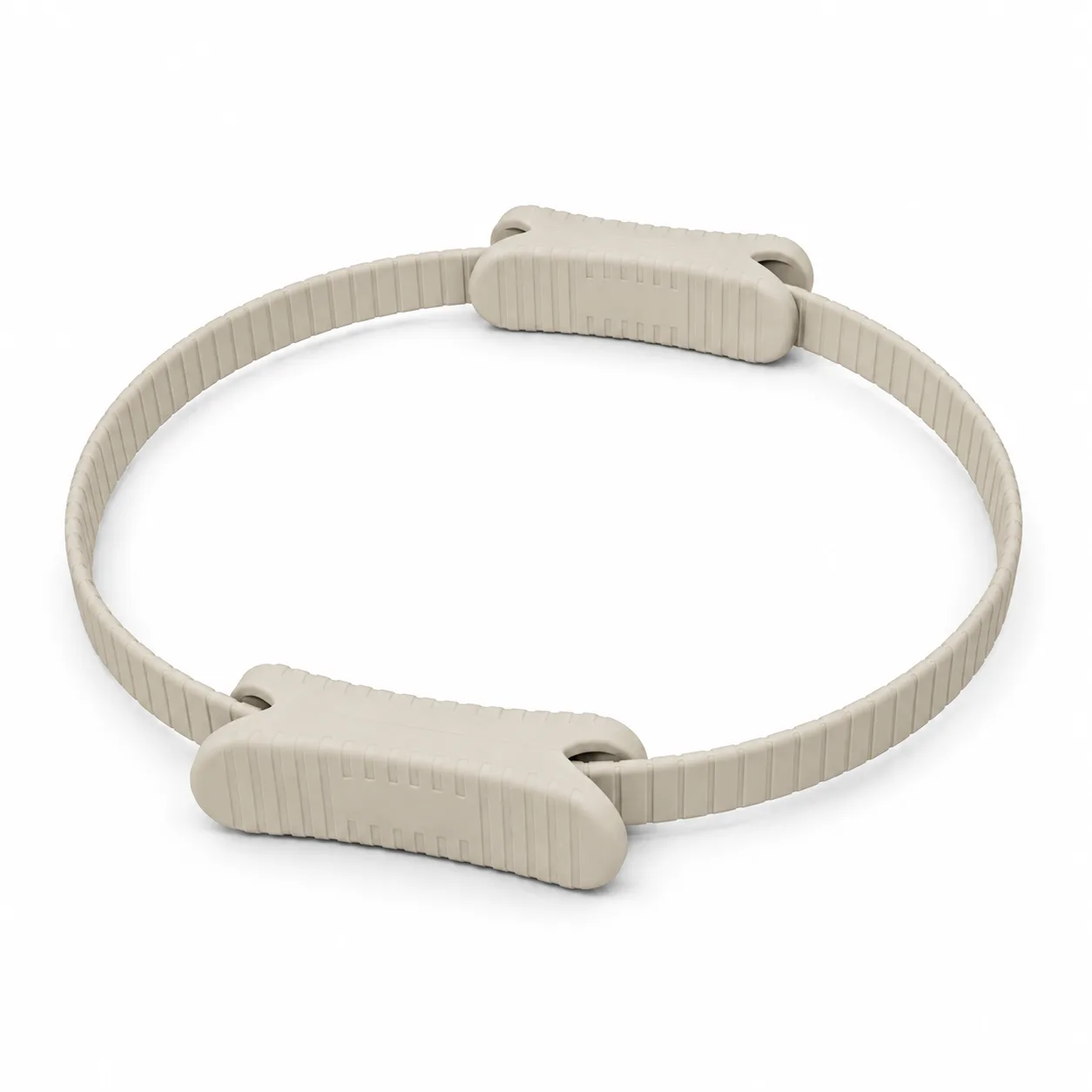
Because magic circles are compared by diameter and handle style, matching the circle’s geometry to your stature directly affects joint alignment. Dual-pad handles feature contoured inner and outer crescents that sit flush against flat bony or muscular surfaces whether you are compressing inward or pressing outward. When you want to alternate between firm spring-recoil resistance and yielding unstable support under the sacrum or thoracic spine, you can pair your ring work with an inflatable mini stability ball from the Pilates Balls collection.
Three Common Mistakes With Pilates Ring Benefits and How to Fix Each One
Even experienced students can sabotage pilates ring benefits by treating the circle like a heavy gym gripper rather than a neuromuscular alignment tool. Below are the three most frequent form errors observed in mat and Reformer sessions—along with immediate biomechanical corrections.
Crushing the Circle With Superficial Chest and Wrist Flexors
- Why It Happens: When holding the ring at chest height during seated twists, roll-downs, or standing arm series, practitioners often try to bend the circle into a narrow oval by curling their wrists inward and rounding their shoulders forward.
- What It Costs You: Over-squeezing shuts down the serratus anterior, elevates the scapulae toward the ears, and shifts tension into the forearm flexors and anterior deltoids instead of the deep abdominal wall.
- The Form Fix: Keep your wrists neutral and fingers long across the outer handle pads, pressing only through the heel of each palm. Initiate a gentle inward pulse from the underside of your armpits as if drawing your shoulder blades wide and down your ribcage, stopping at a mild-to-moderate compression threshold where your collarbones remain completely broad.
Letting the Ring Snap Open During the Eccentric Return
- Why It Happens: During inner-thigh bridges or side-lying ankle presses, students focus entirely on the inward concentric squeeze and then relax completely, allowing the ring’s elastic recoil to bounce their limbs apart.
- What It Costs You: Abruptly releasing tension sacrifices the eccentric phase of muscle contraction—where connective tissue resilience and motor control develop—and jars the sacroiliac and knee joints out of alignment.
- The Form Fix: Treat the outward return of the magic circle as half of the exercise. After exhaling into a controlled press, inhale slowly as you resist the ring’s expansion back to its resting shape without ever losing light skin contact with the foam pads.
Placing Handle Pads Directly Across Joint Lines or Uneven Levers
- Why It Happens: Rushing between exercises leads practitioners to wedge the handle pads directly against the medial knee joint, across the ankle bones without shin alignment, or asymmetrically with one pad higher than the other.
- What It Costs You: Direct joint-line pressure introduces valgus or varus shear stress at the knee and causes the ring to twist or pop out mid-set.
- The Form Fix: Position the crescent pads on the muscular belly of the distal inner thigh slightly above the knee crease, or above the ankle joint along the lower shaft of the tibia and fibula. Before applying force, verify that both pads sit at identical heights and that the circle plane is perpendicular to your spine.
Self-Check Alignment Protocol Before Your Next Session
Following a structured pilates ring guide ensures every repetition reinforces axial length rather than compensatory gripping. Whether you are evaluating the best pilates ring for reformer crossover drills or refining your daily floor routine, run through these practical pilates ring tips before your first squeeze:
- Establish Axial Length First: Inhale to lengthen the crown of your head away from your sit bones or tailbone before applying any pressure to the pads. Compression should never shorten your spine.
- Verify Three-Point Pad Contact: Check that the center of each crescent pad rests evenly against your target contact zone (heels of the palms, distal inner thighs above the knees, or outer lower shins) with zero twisting of the ring frame.
- Sync Compression to the Exhale: Begin your gentle inward or outward press at the start of a steady pursed-lip exhale so the diaphragm, pelvic floor, and transverse abdominis fire slightly ahead of your limb musculature.
- Cap Effort at Sub-Maximal Tension: Aim for a steady, sustainable pulse rather than maximum deformation of the ring. If your neck tenses, your breath catches, or your lower back arches off the mat, reduce your squeeze pressure immediately.
- Audit the Eccentric Release: Count a smooth, unhurried return on every inhale so the circle never rebounds faster than you compressed it.
Frequently Asked Questions
How does a Pilates magic circle ring compare to basic thigh squeezers for inner-thigh and full-body Pilates exercises?
Pilates rings (magic circles) are compared by ring diameter and dual handle style, offering broader exercise versatility for mat routines than single-pattern plastic thigh squeezers. Because a magic circle uses a symmetrical circular frame with inner and outer crescent pads, it supports bidirectional resistance—both inward adduction and outward abduction—across upper-body, core, and lower-body positions, whereas a hinged plastic thigh toner restricts movement to a single inward V-squeeze.
What is the most common mistake people make with what does a pilates ring do?
The most common mistake when learning what does a pilates ring do is over-crushing the circle with maximum force using the wrists, neck, and superficial chest or hip flexors. Instead of trying to flatten the ring, use a controlled, sub-maximal pulse initiated on the exhale from your deep core and scapular or pelvic stabilizers, and resist the spring recoil smoothly on the inhale.
How does pilates ring benefits affect alignment and muscle activation in Pilates?
Understanding pilates ring benefits centers on closed-chain neuromuscular feedback: pressing into or outward against the dual handle pads recruits the transverse abdominis, pelvic floor, adductors, abductors, and serratus anterior simultaneously while giving your body a clear physical midline reference that keeps the shoulders, ribcage, and pelvis stacked.
Make it part of your practice
Explore the blush pilates ring with white pads and check its product details before choosing your studio essentials.
View this piece